Cosmogrammes, by Sara Ouhaddou
Curator: Ludovic Delalande
Welcome to the exhibition of the artist Sara Ouhaddou. Do you hear her voice? She recounts her encounters with artisans. Listen to her stories and try to recognize the sounds she has recorded.
Sara uses the walls of her studio to reflect and create her works. She connects images, objects and texts — this is what she calls a cosmogram. You can read her thoughts by following the lines that go from one idea to another. A cosmogram is a kind of mental map. And you, what do your thoughts look like?
French-artist of Moroccan origin, Sara Ouhaddou develops a practice based on collaboration, dialogue and transmission. At the intersection of art and craftsmanship, her multidisciplinary work revisits traditional know-how – gestures, forms, materials, colors – according to creation protocols focused on listening, exchange and reciprocity.
For more than ten years, she has regularly collaborated with artisans in Morocco, France, Italy, Japan, the United States, Tunisia and, more recently, Uzbekistan. Each project is born from an encounter – territory, memory, object or story – and is developed in an evolving process that the artist conceives as a collective act.
Conceived as tools of emancipation, the exercises she proposes question power relations between art and craftsmanship, modes of production, and the political or social stakes of intangible heritage.
This exhibition brings together a representative set of her approach, mixing recent and never-before-shown works, some of which are made with artisans from the Goutte d’Or neighborhood. From one work to another unfolds a vocabulary founded on an imaginary alphabet, developed since 2015 from Andalusian-Arab architecture, artisan motifs and her relation to the Arabic language — which she does not speak, but which society projects onto her.
Neither readable nor translatable, this system becomes a tool of cultural reappropriation that questions the dominations inscribed in writing.
Throughout the journey, the artist’s voice is heard: for the first time, she speaks while she shows. Designed from testimonies and conversations reinterpreted, the polyphonic sound track acts as a living memory, extending the Amazigh tradition to which she belongs, where transmission is above all oral.
In relation to the works, the cosmograms — mental maps inspired by anthropology — visualize and organize the complexity of the intertwined elements in her works: sociopolitical contexts, temporalities, personal narratives, materials, collaborations. Essential tools usually kept in the studio, the cosmograms relocate each work in its origin and make visible gestures and steps often erased.
This exhibition thus becomes a living archive, a space of circulation between thoughts, gestures and memories: what one keeps, transmits, loses, reinvents, forgets, produces.
Ludovic Delalande
Curator of the exhibition
Room 1
The Uniform, 2023-24
Hand-sculpted ceramic, blue enamel and embroidery on fabric, 81 x 47 cm
Ceramics made by Fouzia Yaagoub, Marrakech, Morocco
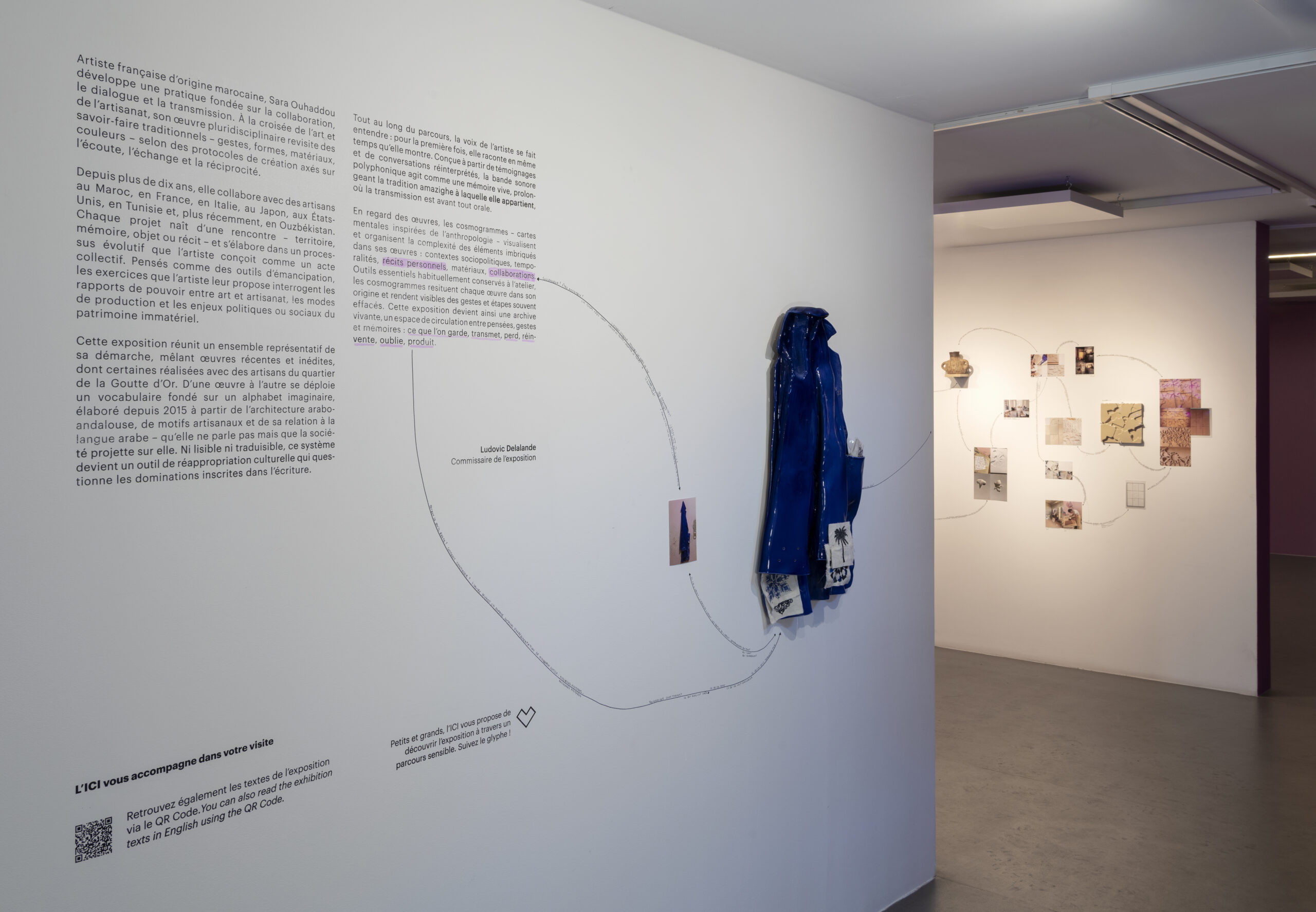
Since 2013, the artist has regularly collaborated with Fouzia Yaagoub, an artisan living and working in Marrakech, to make her ceramic works. The image of the blue work jacket of the latter, hung on the wall of her workshop, left a mark on Sara Ouhaddou’s retina; she first immortalised it in a photograph — like a hollow portrait.
The relationship woven over the years between the two women allowed the artist to deepen their collaboration by proposing her an unprecedented exercise: to model in ceramic her iconic work jacket. Thus, true to her approach, the artist invites the artisan to explore techniques that are unfamiliar to her. Through this protocol, the artist led the artisan to produce her self-portrait through her own medium.
In the pockets of this jacket, there are embroideries made by Amina Hassani, another artisan with whom the artist regularly collaborates; these reproduce motifs chosen by the latter. Here, two know-how usually separated meet and open the way to new possibilities.
Halima, Moulay Bousselham, 2022-24
Fadma, Ain Jemaa, 2019
Touria, Meknes, 2024
Three photographs printed on wallpaper, stained glass, 240 x 320 cm each
Stained glass made by Marie Grillo, Paris, France
Photography has always accompanied Sara Ouhaddou’s artistic practice. Armed with her mobile phone, the artist captures, during her researches and travels, atmospheres, textures, materials, colors, people around her or contexts – so many sources of inspiration to which she continuously returns to feed her creation.
Only recently did she choose to bring these images out of her studio to present them as works, in different formats. Presented here on a monumental scale, these photographs mounted on the wall show portraits of women from her family, taken in moments of their daily lives in Morocco: her aunt in a mint field at Moulay Bousselham, her grandmother in front of the door of her house, and her mother in the medina of Meknès.
At the request of the models, the artist chose to hide their faces behind stained glass that she imagined from unique alphabets, specific to each. These three women, constant sources of inspiration, embody for the artist the heritage of knowledges and their transmission.
Room 2
The women in Sara’s family are at the heart of her artistic practice. Her mother, aunt, and grandmother passed on their skills and craftsmanship to her. She pays tribute to them with these large photographs, without showing their faces. Can you guess who is who?
In the center, the small garland of stars was created by Sara for her daughter. Now it is her turn to pass on the skills she has learned. Imagine them all together in this room…
Hiba, 2025
Glass and steel garland, 300 cm
Assembly by Léa de Cacqueray, Paris, France
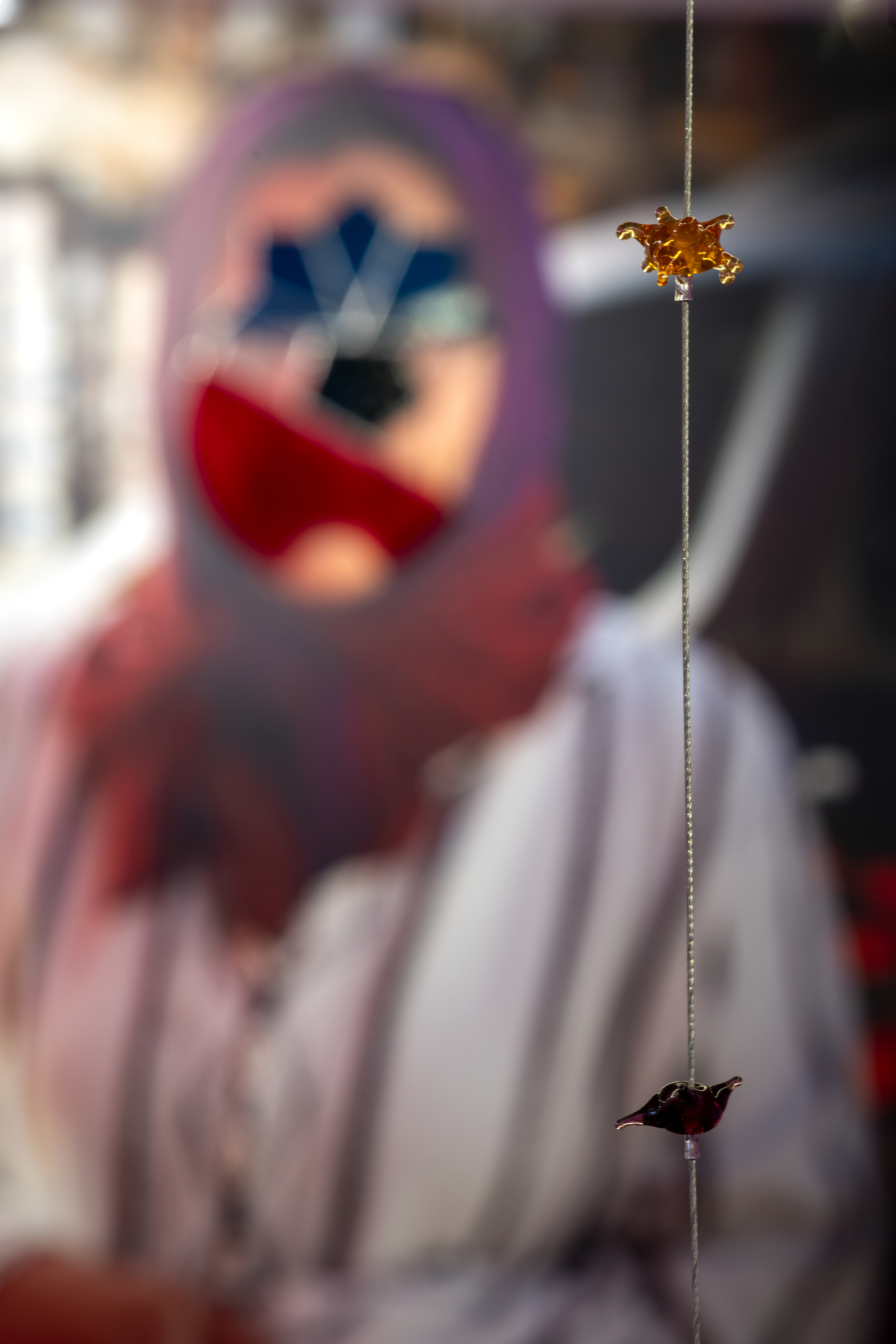
This garland is inspired by the one that the artist had designed for her daughter Hiba so that she could play in her studio. This homage work embodies the act of transmission to the future generation, leading the artist to become aware of her role as a transmitter in turn.
Room 3
Do you feel that smell filling the room? Did you recognize it? These sculptures are made of Marseille soap, with pieces of ceramic placed inside. Here, Sara recounts the story of a very old cemetery of potter artisans discovered in Marseille. As it remained hidden for centuries, these artisans have been forgotten. The objects found show that their technique was nourished by exchanges with the Arab-Muslim world.
I give you back what belongs to me / You give me back what belongs to you, 2019
Twenty-eight blocks of Marseille soap (made in the Le Fer à Cheval soap factory) and embedded pieces of ceramic
Ceramics made in collaboration with Marine Daniel
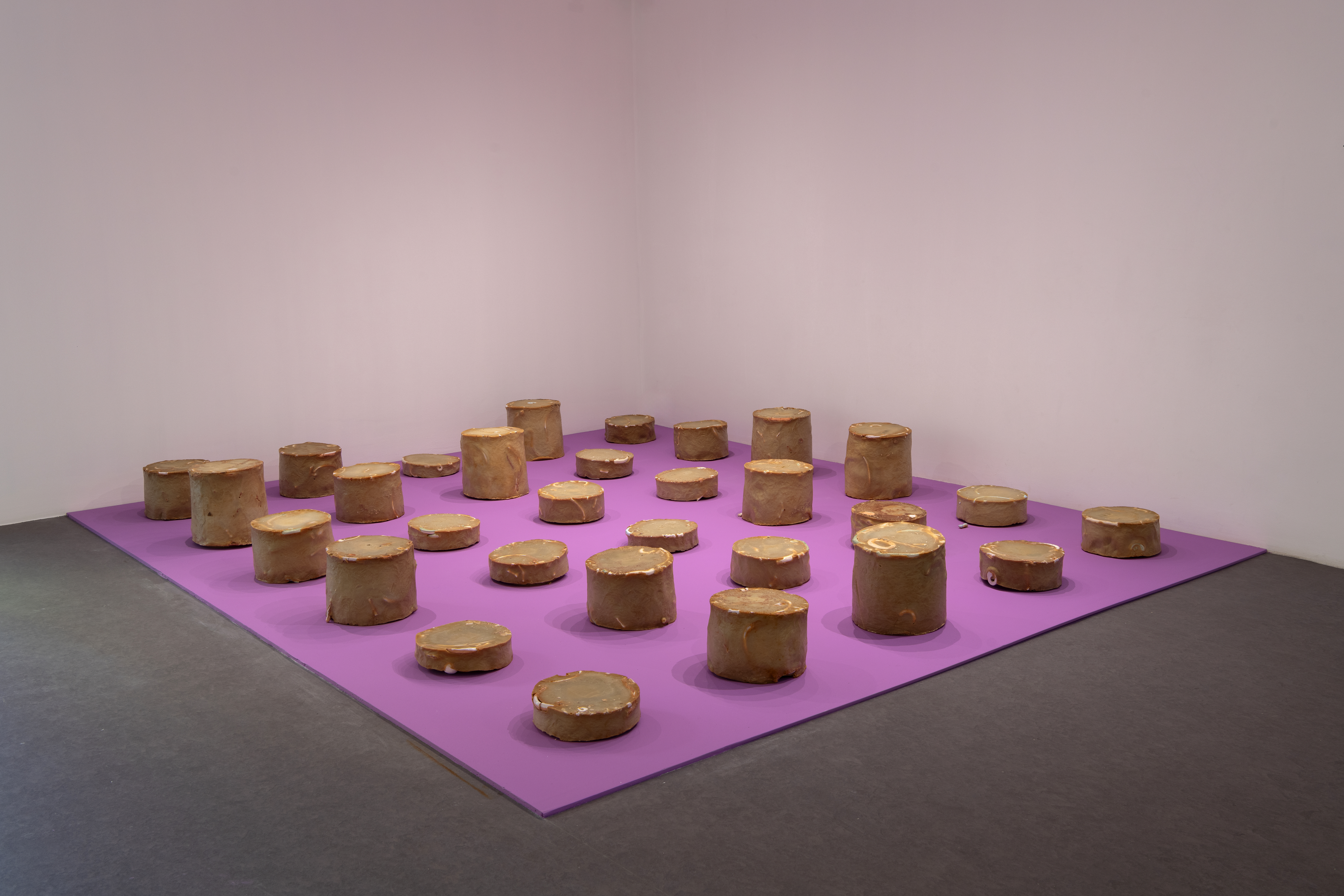
This installation, made in Marseille soap, is a reduced version of a work conceived by Sara Ouhaddou during an artistic residence in Marseille in 2019, and presented as part of the Manifesta 13 exhibition. Through this domestic, sensory and ephemeral material, the artist explores the themes of the transmission of knowledges, the history of alphabets and ordinary gestures.
The soap blocks, cast by one of the oldest soap factories in the city, “Le Fer à Cheval”, are embedded with fragments of ceramic, giving the work an archaeological and memorial dimension. The appearance of the blocks wavers between that of a sculptural column and that of an earth block taken from an archaeological dig site, suspended, waiting to be analysed.
Some of those fragments come from objects excavated in Marseille, thereby evoking historical exchanges between the Arab-Andalusian world and the city in the Middle Ages. Through this work, Sara Ouhaddou offers a poetic reflection on restitution, circulation and transformation of knowledges, through simple objects charged with memory.
The installation thus becomes a place of crossing between past and present, between the intimate and the universal, by questioning the invisible traces left by History.
Mashiko, 2018-23
Ouarzazate, 2018-23
Tokyo, 2018-23
Zerhounia, 2019-23
Moulay Idriss, 2017-23
Five photographs on ultra smooth Hahnemühle paper, 40×40 cm each
Armed with her mobile phone, which she particularly appreciates for its simplicity and immediacy, the artist captures, during her research and travels, atmospheres, textures, materials, colours, people in her family or surroundings or still atmospheres dear to her. Piled in her studio or pasted in her notebooks, these standard 10×15 cm prints are so many sources of inspiration to which she keeps returning constantly to feed the creation of her works.
Here, the artist has chosen to isolate five photographs of square dimensions taken in Morocco and Japan and to present them in metal frames.
An artisan who shows us his most intimate tool: his palette of colours.
The stained glass window of a restaurant in the midst of a desert of sand and stones.
There are elements, compositions, arrangements, colours that fascinate me and that will turn into my obsessions.
The objects of great finesse in the streets of Tokyo.
The neon nougat from the street vendor in front of the mosque.
My mother and my aunt who blend in with the colors of the house.
– Sara Ouhaddou
Room 4
This work is composed of ceramic beads, blown glass and stained glass, that is to say an assembly of colored glasses. They are held in balance. Imagine the sound they would make if the wind passed through them. These types of works are called mobiles because they are always in movement. The different stained-glass pieces come from a repertoire of forms created by Sara, like a suspended language in the air.
There is always one above, there is always one below, 2025
Metal, stained glass, blown glass beads and ceramic beads, 15 m
Installation inspired by the poet Mririda n’Ait Attik
Stained glass made by Marie Grillo, Paris, France
Ceramics made by Alice Nikolaeva, Paris, France
Assembly by Léa de Cacqueray, Paris, France

Designed for the exhibition, this glass installation, which unfolds in two contiguous rooms, is a new iteration of a long-term research, initiated in 2019 around the history of glass and its know-how in the Mediterranean, and especially in North Africa. The artist began with an exploration of stained glass historically used in the houses of the medinas, before turning to everyday objects of daily life.
This new collaboration marks the meeting of different techniques of working with glass: European tradition stained glass, with Marie Grillo, and the making of beads from Syria, with Edgar Youssef, a master glassmaker of Syrian origin settled in the Goutte d’Or neighborhood. The ceramic was made by Alice Nikolaeva and the assembly of the whole was ensured by Léa de Cacqueray.
By superposing time and the transformation of materials, this work can also be read as a portrait of their evolution through the gestures that shape them – from the bead, an ancestral form, to the blown glass, the most recent expression, passing through stained glass.
Conceived from an initial drawing made by the artist, this garland of mobiles inaugurates a new form of visual writing, made from a mix of existing objects available with the artisan and specific creations.
Room 5
These strips of fabric are made of bazin, a glossy and stiff cloth often used to make clothes in West Africa. They have been embroidered and sewn by Lamine, Amadou, Abou and Boubakary, four artisans from the Goutte d’Or neighborhood (where we are here). Sara showed them water-colours she had drawn and proposed that they transform them into embroideries using their know-how. The artisans each have their favourite technique.
One works with satin stitch, another with chain stitch… Can you see the differences?
The Confetti Room, 2025
Twenty-two pieces of machine-embroidered bazin and made in the Goutte d’Or neighborhood, various formats
Embroideries made by Amadou Barry, Abou Ouattara and Boubakary Sidibe, Paris, France
Sewing done by Lamine Diallo, Paris, France
Since 2013, Sara Ouhaddou has taken up embroidery to question and deconstruct specific local Moroccan identities – those of Tétouan, Rabat, Fès, among others. In her collaborations with traditional hand-embroidery workshops, she encourages women – who generally embroider with a view to constituting the dowry for their future marriage – to challenge traditional stitches and to experiment on atypical materials, such as rubber.
On the occasion of this exhibition, the artist launched a new collaboration with three embroiderers originating from West Africa, whose workshops are located in the Goutte d’Or. Specialists in embroidery on their traditional ceremonial textile, the bazin, these artisans were invited to reproduce the coloured forms of the artist’s characteristic alphabet.
Through this gesture, Sara Ouhaddou moves embroidery, usually associated with clothing, into the domain of architecture by producing panels of fabric that cover the walls of space. In Morocco, embroidery is also used to ornament ceremonial furniture, like wedding seats; an approach which the artist takes up here in a renewed register.
Room 6
The stained glass boxes are like treasure chests. They diffuse all their colours into the room. Inside, there are small horses made by the Abiad family jewellers in Marrakech. When Sara asked them to imagine an object, the artisans chose to be inspired by the fantasia. This is an Amazigh traditional festivity, where horse riders reenact military scenes. These small metal horses resemble precious jewellery or game pieces.
Imagine their weight. Imagine their temperature.
Derb Dabachi Display Cases, 2023-24
Stained glass, jeweller’s cavalier pieces, glass, brass, copper and silver, various formats
Stained glass made by Mohamed Maaroufi, Marrakech, Morocco
Jewellery made by Omar Abiad and Ihya Abiad, Marrakech, Morocco
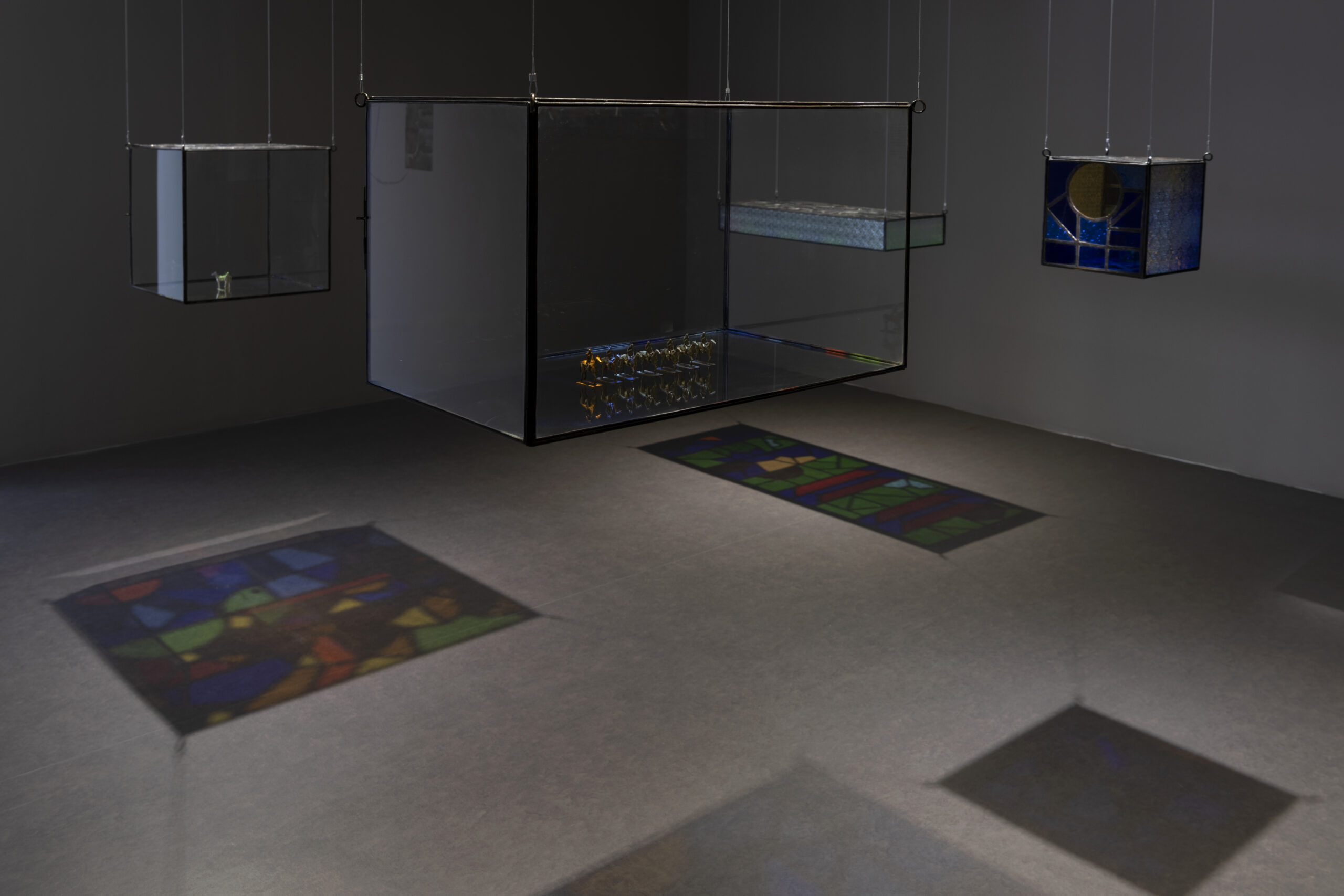
Emblematic of the unprecedented crossings the artist likes to provoke, this new series of works combines her long-term research on glass and the creation of jewellery, as well as on presentation devices of products for sale. It thus questions how craftsmanship shows itself in the medinas today.
Faced with the growing increase of tourism, many artisans desire to adopt the codes of commercial display — standardized shop windows, accumulation of objects, accentuated lighting — while others turn away from them or play with them, creating a discrepancy in the perception of objects which, however, remain identical. This shift testifies to a radical transformation in the reading of these artisanal forms.
Made by the artist and Mohamed Maroufi, each of the display cases consists of a set of glass panels, some treated as stained glass, evoking the motifs of traditional houses. In their centre, small metal sculptures, made by the Abiad family of jewellers, are inspired by the fantasia – a spectacular equestrian tradition that stages horsemen in ceremonial dress performing synchronized charges and gunshots to celebrate Morocco’s warrior and cultural heritage – diverted here in a miniature and ornamental format.
Each display case is a way for the artist to reconnect with her first job as a visual merchandiser for product presentation, which allowed her to finance the beginnings of her artistic practice and to make that know-how available to artisans. She thus raises a question: how can an artwork be directly in the service of the artisan?
Room 7
The ceramic pieces in these works are assembled like a puzzle which picks up the forms of the alphabet created by Sara. She imagined musical scores to represent The Songs of the Tassaout by the Amazigh poet Mririda N’Ait Attik. Can you see the notes, invent your song? These ceramics and the blue jacket at the entrance of the exhibition were made by Fouzia, an artisan who lives and works in Marrakech. Sara has collaborated with her for a long time.
Partition 5 and 6, 2024
Glazed ceramics, 124 x 90 x 5 cm each
Ceramics made by Fouzia Yaagoub, Marrakech, Morocco
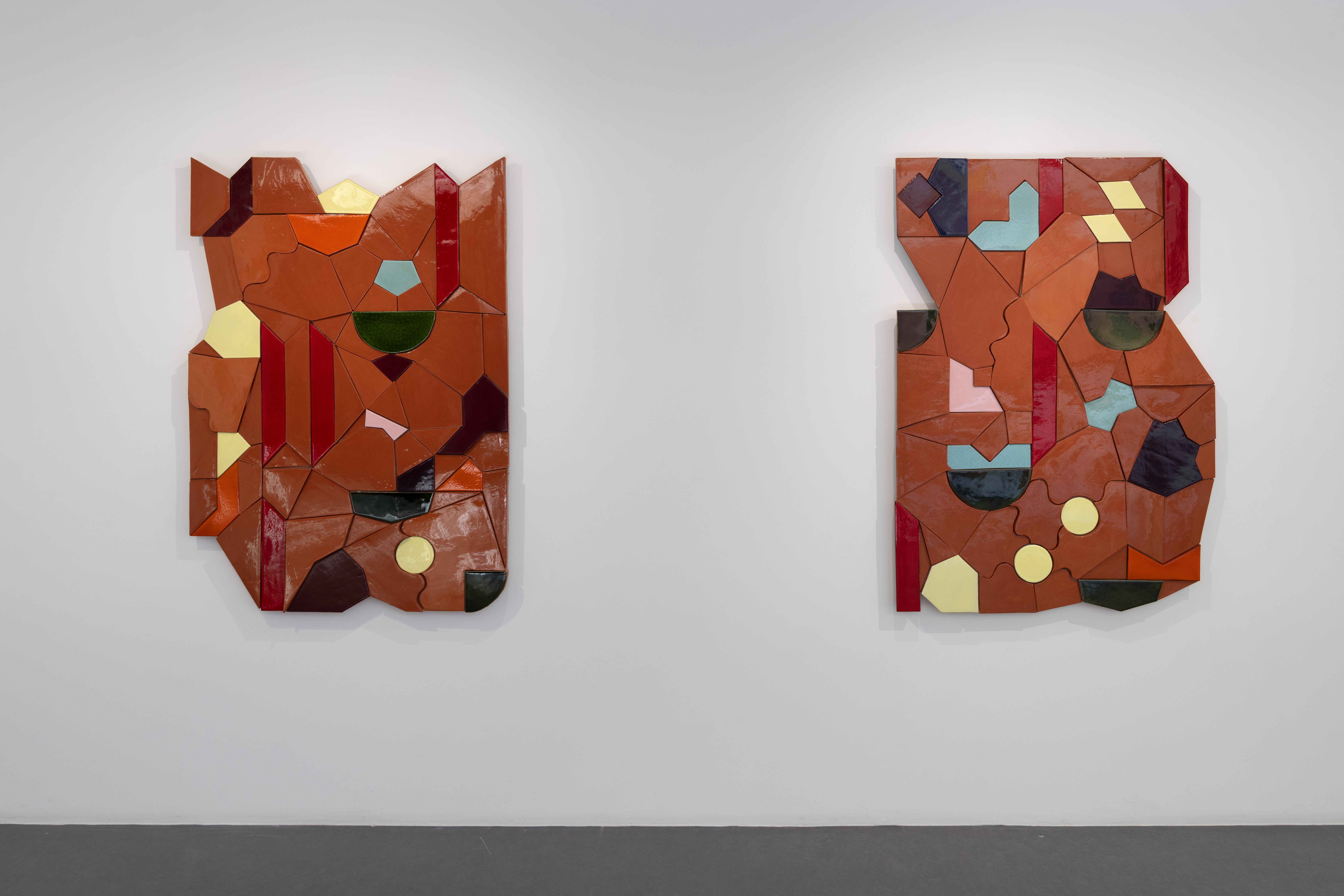
Her first collaboration with artisans began with ceramics, in 2013, alongside embroidery. Iconic of Moroccan craftsmanship, ceramic – like weaving – is one of the oldest recognized and celebrated artisanship forms, with gestures perpetuated over millennia. Artisans continue to reproduce the same objects using techniques transmitted from generation to generation.
Faced with this observation, the artist sought to go back to the origin of these gestures to better deconstruct them and invite the artisan to rethink their production, in order to try to answer a question: can craftsmanship still be a space of innovation or must it resign itself to the incessant repetition of a fixed gesture? To do this, Sara Ouhaddou started from a simple form: the ceramic tile used in the making of classic zellige.
Zellige is a traditional Moroccan art of mosaic made of small glazed ceramic tiles, assembled with precision to form complex geometric patterns, often used in Islamic architecture. Made by Fouzia Yaagoub from a drawing by the artist, these panels are composed of abstract forms – her alphabet of coloured shapes – whose assembly, conceived like a puzzle, evokes the sound of Amazigh songs* from which they draw inspiration.
Room 8
Sara’s alphabet appears on the windows of the building and colours the light. She associates abstract shapes to make words, sentences, poems. This tinted light makes us see the space differently, both inside and outside. Look outside through the coloured shapes…
Untitled, 2025
Colourful shape vitrophany. Free exercise from audio recordings in weaving workshops in Imlil in Morocco. Traditional Amazigh songs of the High Atlas
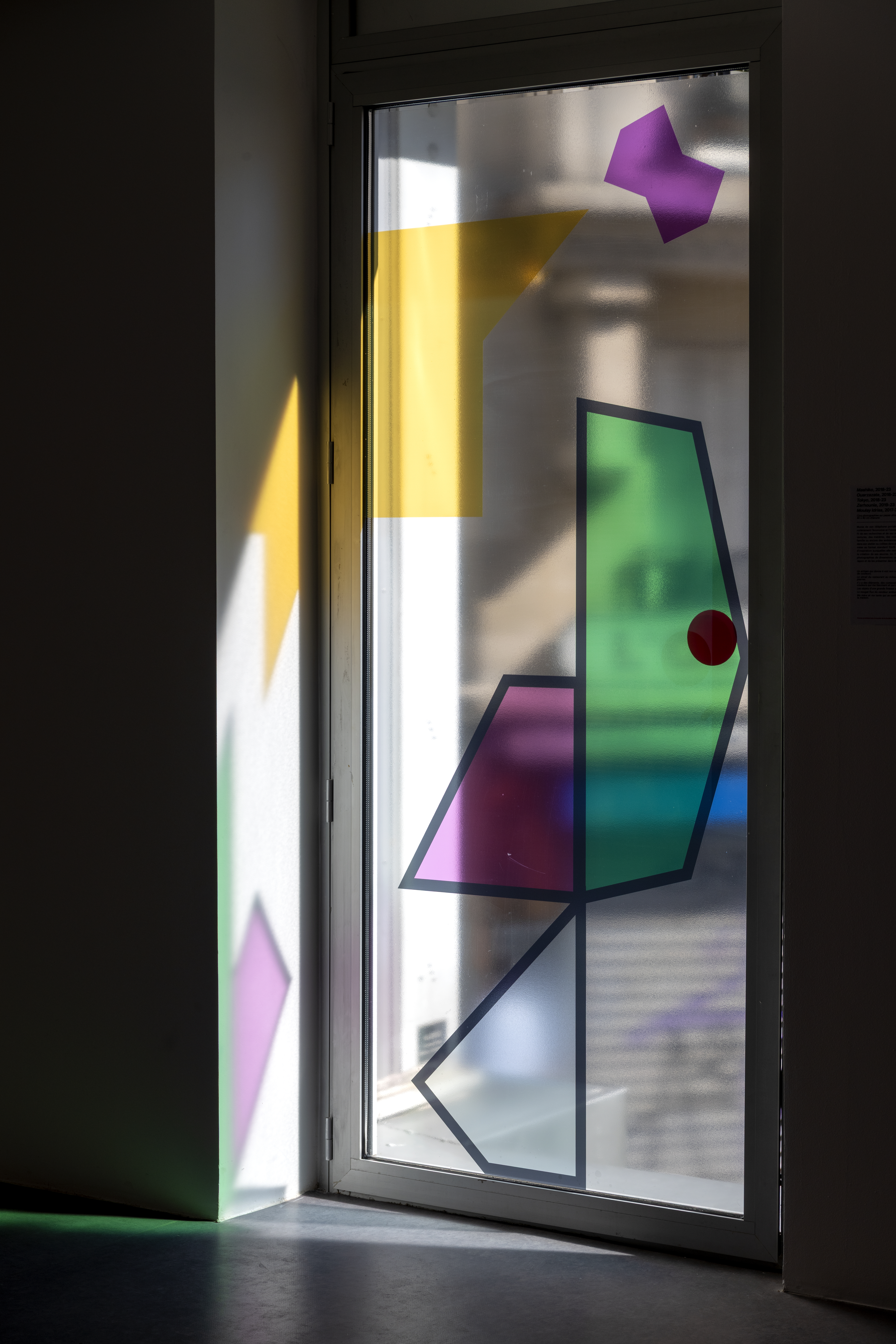
The artist proposes an intervention on the glass windows of the exhibition space, applying the coloured shapes of her visual alphabet, thus dialoguing with the architecture. This approach finds its roots in her past as a merchandising designer, where space had to reflect the objects or products on sale. Here, space becomes a distorted mirror of the works.
The windows allow her to explore the same freedom that painting offers, playing with the material of glass, colour and transparency. By investing the architecture of the building, the artist produces an ephemeral and unique work, like the orality she mobilises in her works.
