Le bal des Ogresses (Ogress Ball)
Welcome to The Ogress Ball.
Beware!
The ogress is a demon.
No, a woman.
Or rather, a beast.
But no, wait—the ogress is a goddess.
No, no, the ogress is a powerful djinn.
The ogress is a shape-shifting monster.
Ambivalence is the rule.
It’s enough to drive you crazy!
Opposites coexist, live side by side, feed off one another, and
enrich each other.
Some say the ogress is seductive but deadly.
Others, on the contrary, describe her as ugly and protective.
But everyone agrees on one thing: her feet.
The ogress is recognizable by her goat-like hooves.
And by the fact that the ogress, true to her gluttonous nature,
devours.
She devours with rage, desire, hunger, vengeance, love,
motherhood…
Her appetites are insatiable.
Among her favorite delicacies: colonists, violent men, and
disobedient children…
We can try to define the ogress, to write about her, to depict her,
but we will never be able to fully grasp her.
The ogress cannot be digested.
She slips through our fingers.
She eludes our all-too-human minds.
She flees our decidedly too-patriarchal world.
The ogress joyfully subverts colonized thought.
Welcome to The Ogress Ball!
The exhibition, which brings together thirteen artists, highlights marginalized narratives and weaves together overlooked genealogies to create living archives – oral images of the ogress, who is here reimagined as a proto-feminist, queer, decolonial, Arab-Amazigh, pre- and post-Islamic figure.
There is no fixed image of the ogress. She exists only through the voices of those who have been telling stories about her, speaking of her, and invoking her for millennia.
The exhibition is thus an invitation to recall and honor the stories our mothers and grandmothers told us… All these voices that have been singing – for generations and across the borders of the Mediterranean– of women’s power, their resistance and resilience, their anger and love, their outbursts and their tremors.
The exhibition is an invitation to devour.
A critical and utopian devouring.
Poetic and political.
An elusive and ever-changing embodiment, the ogress reveals herself to be immense and multifaceted.
Unique and variable.
And above all, alive!
The ogress lives, survives, deviates, subverts.
She transforms herself, reinvents herself.
The ogress resists norms, conventions, and colonization.
She defies both injunctions and definitions.
The ogress devours, overflows, unsettles.
Long live the ogresses!
Life is pure devouring.
– Sonia Recasens
Exhibition Curator
Room 1
Lucile Gauthier
Sharp Dance, 2026 (wall drawing)
Beautiful Knives & Love Forever, 2026 (wall drawing)
Aïcha Kandisha, 2022 (Nero pencil on paper)
De langue et de couteau, 2026 (Nero pencil on paper)
Des yeux sous les pieds, 2026 (Nero pencil on paper)
Mimouna, 2026 (Nero pencil on paper)
Ogresse du lac, 2026 (Nero pencil on paper)

Illustrator and comic book author Lucile Gautier brings
to life, through a clear yet slightly rough line, a multitude
of ogresses imagined in collaboration with the poet Mo Abbas
in the Dictionnaire des Ogresses, published in 2023 by
Le port a Jauni. For this exhibition, Lucile Gautier has been
invited to showcase and reinterpret her mischievous ogresses
within the spaces of the ICI.
And you, what kind of ogress are you?
My ogress isn’t very tall, but her heart is big, heavy, brimming with stories.
My ogress is in great shape; she diligently works out her thighs at the gym so she can run after life better – she just doesn’t have the time.
She wants it all—the butter, the money from the butter, the smile of the dairymaid, even her sweat and the CEOs’ resentment. So much the better if these gentlemen feel ashamed and sullied in their little, very expensive suits when she boos them.
She’s a bit scruffy, talks with her hands, thinks out loud, wears mini-shorts and platform sneakers.
My ogress hates a lot of things, like order, terfs, or startup founders, but when she loves, she gives endlessly; she’d even be capable of cooking you her own heart, with garlic and parsley.
L. G.
Amina Benbouchta
Mother, 2015 (neon lights, electrical wires)
Aïcha Kandisha, 2021 (photograph, mirror, caftan on a mannequin, chair, animal)
Holopherne, 2020 (cotton shirt collar)

Amina Benbouchta’s multifaceted body of work embraces mischief and ambiguity to explore the place and future of women in contemporary society. At once familiar and strange, alluring and unsettling, her meticulously crafted installations – which blend sculpture, installation art, and photography – invite us to step through Alice’s looking glass to discover the ambiguity of a reality full of pretense beneath the glossy veneer of seemingly harmless household objects.
And you, what kind of ogress are you?
I am the shape-shifting ogress, the ogress and her wardrobe of forms – each one is merely a reflection of your own fears: that is my strength.
My suspended caftan is a shell emptied of its substance.
I am a wavering presence, a mirror of your anxieties, which repeat themselves endlessly in the labyrinthine mirror.
No one can grasp or see me, for what I allow you to glimpse of myself is constantly transforming, like a truth that can never be attained.
My metamorphoses are those of your anxieties – the ones you cannot escape.
I am the ogress who cannot be caught, the one who slips through the birdcatcher’s net.
The cage of my crinolines is always empty; it is an absence.
A. B.
Rim Battal
La sieste de la goulue, 2026 (embroidered text on bed linen and underwear, a work created in collaboration with Amadou Barry)

A leading figure in contemporary poetry, Rim Battal plays with words and images, sounds and meanings to explore the body politic, desire, motherhood, love, and resistance, cultivating the intertwining of sexual and intellectual appetites: one thing leading to another, biting into the Adam’s apple is to embrace, in a single bite, both knowledge and carnal pleasure.
And you, what kind of ogress are you?
I am the one who, ravenous, devours letters, books, commas. Not gluttonous, not bulimic: I devour them, I ingest them after having searched within them for a long time, after having long sought to understand what, of myself, could possibly exist there. From “What, of myself, can exist there?” ” I move, through ingestion, toward “what part of myself can I bring into being there?” So I devour what I love. I devour because I love. Because I want it for myself. Because I want to have it within me: I make a place for it inside me. I eat it my way. I season it, I engage in a dialogue through my stomach and my senses, I mix it with my hands, I toss in dried and ground roots, bay leaves, and rosemary cultivated in my memory. I crush, I mix, I taste with my fingers, I lick them. I add salt when people want me to be mild, chili pepper when they want me to be easy to digest. It passes through my body, takes something from my flesh, my tongue, my scents, my fluids, my secretions. I devour the books I love until they become a little bit of me and I am made up of them.
I’m that ogress. The one who, for lack of cutlery and napkins with her initials on them, eats with her hands, right off the floor.
R. B.
Room 2
Imane Elkabli & Rim Mejdi
Aicha4 197Au (7Li,3n) 201Pb, 2026 (three projections onto aluminium, fabric and televisions, with a soundtrack)

For the exhibition, Rim Mejdi, producer and director, and Imane Elkabli, choreographer and dancer, were invited to collaborate as part of a creative residency with the “talented mothers” of the Dar Bellarj Foundation in Marrakech.
Through an immersive installation comprising videos, photographs, performances, and sculptures, the artists explore the multiple incarnations of Aïcha that populate landscapes, haunt the imagination, and inhabit bodies. Earth, water, fire, and bodies merge in a sensory experience.
The title of the installation is a mathematical – or rather, alchemical – formula for transforming gold into lead… the metal associated with Aïcha.
And you, what kind of ogress are you?
The ogress slumbering within me takes on all forms of life.
Today, she is afraid, but she remains powerful and immense, like a black mare running free, knowing no earthly boundaries.
Only the sky watches over her.
The ogress slumbering within me dances, sleeps, and fights.
She can never be defeated or tamed.
She is a dark and indomitable force – she does not yield.
She chooses those she loves and cares for them, and she drives her enemies far behind her.
The ogress slumbering within me changes shape.
She takes on many forms, sometimes even contradictory ones.
She devours every form of life… and its opposite.
Yet she settles into three states.
The sleeping ogress, the warrior, and the dancer.
When she dances, nothing else matters to her: she savors the moment, the joy of singing and being free.
When she fights, she is like the waves of the sea, sweeping everything in her path.
When she sleeps, she curls up into a ball and falls into a deep slumber.
The ogress slumbering within me is a massive black mare.
She gallops, pounding the ground with her hooves; no one will ever be able to outrun or tame her.
I. E.
And you, what kind of ogress are you?
Furious, combative in the causes that stir my heart, an ogress brimming with fears to confront, with a desire to explore the hidden and the unknown in the shadows of my being and those of my own culture.
Devouring becomes an act of creation, caught between the annihilation of what restricts and the emergence of the new.
I like to imagine myself as an ogress who tends to the monsters that society has decided to exclude.
Through my artistic practice, my rage becomes substance and movement from the margins toward the world – to make it the focus of attention and the voice.
An ogress in the making, with still so much to learn…
R. M.
Room 3
LALLA RAMI
AÏCHA CANDYSHOP, 2024 (three-minute-and-twenty-two-second music video, shopping trolley, gun, lipstick)

Singer, rapper, songwriter, and composer Lalla Rami released
the track “AÏCHA CANDYSHOP” in 2024: a play on words between the ogress from her childhood, Aïcha Kandisha, and 50 Cent’s 2005 hit, “Candy Shop.” Blending Darija, French, and English, the Moroccan star lashes out against the demonization of powerful women and the fetishization of trans women of color in a music video for which she served as artistic director.
And you, what kind of ogress are you?
I am the ogress who never was one.
Constantly distorted, overwhelmed, terrifying to those whose hearts are corrupt, but exceptionally beautiful to those who don’t have shit in their eyes and refuse to submit to the violence of this world.
I am the ogress who feeds on the flesh of adults who have chosen to perpetuate the evil they have suffered rather than fight against it.
I could be a witch, a mermaid, a centauress, a fairy, but perhaps I am far too beautiful to be an ogress.
L. R.
Silina Syan
J’aurais pas osé, 2019-21 (six photographs, light boxes)

Silina Syan embraces kitsch and excess, over-the-top imagery, and popular culture. In the photographic series J’aurai pas osé, the artist showcases meticulously manicured hands with long nails customized like cars, screaming ostentatious femininity and heightening a menacing power of seduction. Like sharp claws, proudly displayed as a sign of resistance and defiance, these hands attract us as much as they terrify us.
And you, what kind of ogress are you?
I wasn’t born an ogress.
I became one over time, mirroring the evils of the world and the sorrows of my heart.
I’ve learned to collect my weapons and wear them as adornments.
My weapons gleam; they’re gilded, adorned with rhinestones and sequins. Like scales, they capture the light and scatter it into a thousand reflections. They dazzle the enemy.
They are my treasures, my fortress.
I do not seek to hurt; I only seek to no longer be hurt. If anyone comes too close, my adornments become claws.
Some of my weapons gleam on my body; others burst forth from it. I am also an ogress who weeps.
My tears sparkle in the light of day as well as in the glow of the night. They accompany each of my prayers, in which I entrust my wounds and gather what I need to draw strength from them.
From their brilliance comes an elixir for my soul and a poison for those who caused them to flow.
They are my most precious weapon.
S. S.
Room 4
Nil Yalter
Sans titre (Serpent), 1994 (drawing)
This work on paper is inspired by the Serpentine Column in Sultan Ahmet Square, which was erected in 479 BCE at the Temple of Apollo in Delphi before being brought to Constantinople by Constantine the Great in the 4th century. Nil Yalter’s serpent thus becomes a symbol of movement, protection, transformation, and rebirth, echoing the spiral inscriptions on the belly in the video The Headless Woman or The Belly Dance (1974).
La femme sans tête ou la Danse du ventre, 1974 (black-and-white video, 24 minutes 47 seconds)
A historic figure in the feminist avant-garde, Nil Yalter drew inspiration for her first video performance – filmed with a Portapak camera – from rituals practiced in Africa and Anatolia, where women considered disobedient and/or infertile are taken to an imam who writes verses from the Quran on their bellies, in an act of patriarchal control over women’s bodies and sexuality. The artist offers a feminist interpretation of this practice, replacing the religious texts with the words of anthropologist René Nelli on the clitoris, which she inscribes herself on her body in a spiral around her navel to the sound of Gypsy music, performing a subversive belly dance. Through this performance, Nil Yalter asserts female pleasure while denouncing sexist and sexual violence.
La chamane, 1979 (black-and-white video, 7 minutes)
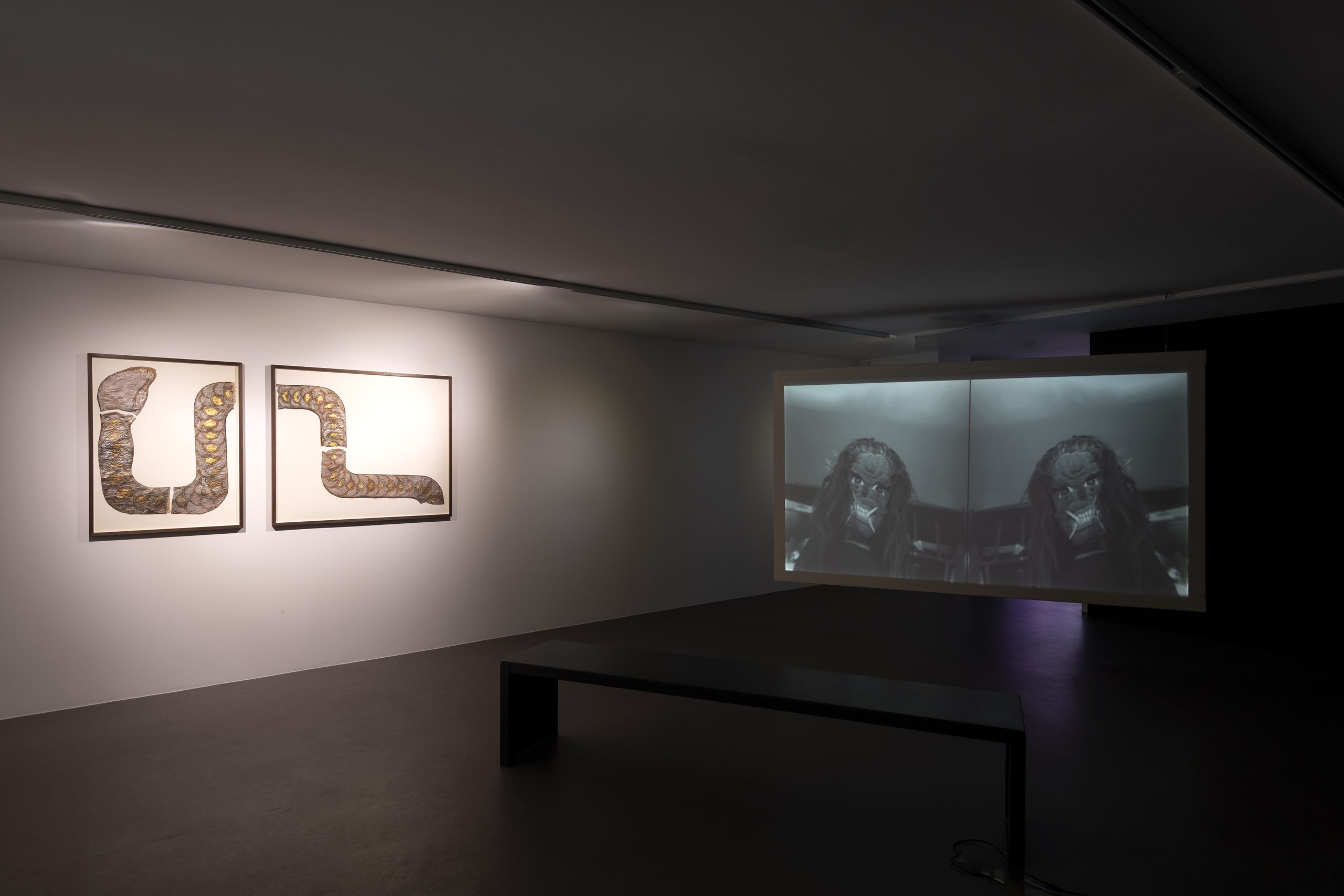
A pioneer in video art and new technologies, Nil Yalter performs a ritual dance in the storage areas of the Musée de l’Homme, bringing to life a mask and objects from the museum’s collections. As if immersed in a trance-like state, accentuated by mirror effects, the artist repeats movements to the increasingly intense rhythm of ritual music from the nomadic Turkish tribes of Afghanistan, preserved by the Department of Ethnomusicology. This work attests to the importance of the figure of the shaman in his artistic practice, which continually forges aesthetic links between performance and ritual, trance and video.
And you, what kind of ogress are you?
“For a multicultural guerrilla movement, new technologies provide an alternative platform, an autonomous zone. By using new media in the realm of art and working on cultural topography, I explore the body of the aging artist in a society in decline. The artist’s body serves as a vehicle for social themes: digitization, virtual forms, words, hypertext, interaction… I am a female shaman walking a tightrope. The surface on which I write my message is my own skin. Like a snake, I leave traces of my skin along the paths I traverse.”
Nil Yalter, interview with Rosemarie Martha Huhn, Contemporary Artists, 5th edition, December 2001, St. James Press, issue 2, pp. 1857–1860
N. Y.
Room 5
Nadira Husain
Gloutonnes (Lumineuses, Violettes, Nuit), 2026 (murals, ceramics and acrylics on canvas)

Influenced by Western and Eastern feminist theories, as well as science fiction literature, Mughal, and Indo-Persian paintings, Nadira Husain has created an original immersive work produced specifically for the exhibition and titled Gloutonnes. Comprising a mural, ceramic breasts, and paintings on canvas, the installation borrows the ogress’s gluttony – here reimagined as a metaphor for hospitality and connection – to bring to life composite bodies of hybrid women capable of tenderly absorbing the Other into themselves.
And you, what kind of ogress are you?
My ogress is a porous, voracious body, where hunger becomes a way of connecting, of welcoming, and of making room.
A gluttonous body that absorbs and digests the stories, cultures, and legacies that pass through it.
She comes from the composite bodies of the Mughal tradition – those figures in which other bodies—animals, plants, or demons – are intertwined – in which I would lose myself and which allowed me to hold on to every part of myself.
She is a bastard.
She carries the power of illegitimacy: the power that claims its place, invents its own language, and transforms what has been passed down to her.
It is the second generation that creates culture.
It is also the choice of a body shared by many. A body in sisterhood, in resonance, permeated by tenderness and complicity. Bodies that touch and extend into one another.
My ogress shits out fish; a rain of fish falls, creating a slippery, shifting space.
And if there is a confluence – Sangam – then the liquids mingle without erasing their differences.
N. H
Room 6
Khadija El Abyad
GHOULAT EN-NIFAS, 2026 (forty-four open A5 notebooks, video on a tablet)

Exploring collective memory and women’s traditions, Khadija El Abyad has created, specifically for this exhibition, an original series of forty-four drawings that bring to life Goulat en-nifas: the ogress of the new mother. An embodiment of postpartum depression, this figure from Moroccan folklore has for centuries crystallized the fears surrounding the first moments of motherhood. These drawings function like entries in a personal journal, like attempts to give form to what is difficult to put into words: an intense experience of vulnerability, transformation, doubts, and emotional turmoil.
And you, what kind of ogress are you?
I am the GHOULAT EN-NIFAS,
I come with the forty-four days, that strange time when the body no longer knows where it begins or where it ends. A time suspended in limbo, when the soul unravels only to recreate itself, slowly, in a different way.
I am the mother of the forty-four.
I carry this number like a body multiplied: forty-four gestures, forty-four vigils, forty-four ways of holding, of nourishing, of carrying, of starting over. I am a centipede, a thousand points of support, moving forward even when I’m no longer quite sure where to place my feet.
Fountains of milk flow from my breasts. I have become a spring.
My milk flows toward him, and his love flows into me. I nourish him; he brings “my heart” to life. I am constantly changing. I have no definitive form. Sometimes human, sometimes beast, sometimes something in between – I am metamorphosis. I am made of fragments, thoughts, sleepless nights, and a body seeking its new form.
I have been given names for what could not be named. I have been portrayed as a presence to be feared, coming to disturb women after childbirth. Yet, in the midst of my dizziness, I overflow with immense love. A love so great that it, too, becomes a force that turns everything upside down. I hold my child close to me, and in this absolute bond, something within me is reborn.
I am also what goes unsaid.
What gets stuck in my throat.
What never becomes words.
When everyone around me keeps saying I should be happy, I blame myself even before I’m blamed. I hold back my tears; I hide my fear, as if suffering made me a bad mother. Fear creeps up on my child precisely because love is so immense.
I am the one who navigates the turmoil without disappearing into it. I fall apart, then I pull myself back together. I don’t go back to being who I was: I become another version of myself.
I am the postpartum ogress.
I devour nothing; I recreate myself.
K. E. A.
Kubra Khademi
Sans titre #6 (qoonos), 2025 (acrylic on canvas)
Sans titre #8 (dame démon), 2025 (acrylic on canvas)
Sans titre #14 (autoportrait), 2025 (acrylic on canvas)
Sans titre #16 (dragon), 2025 (acrylic on canvas)
Women in simple situation, 2026 (video projected onto a table)

Drawing inspiration from her personal history as a woman and a refugee, Kubra Khademi asserts her art as a weapon of resistance and empowerment, deconstructing patriarchal and colonial violence to restore women to their rightful place in history, society, and the public sphere – just as in the great myths of the creation of the world. Through her performances, paintings, installations, and drawings, the artist continually brings to life a pantheon of powerful, free women, liberated from any shame of being women accused of all the evils of the universe. For, ultimately, isn’t women’s greatest crime that of being able to create life?
And you, what kind of ogress are you?
I’m just “me,” and that’s enough for people to see me as a threat.
K. K.
Room 7
Saodat Ismailova
Her Right, 2020 (black-and-white video, soundtrack)

As an artist and filmmaker, Saodat Ismailova weaves together personal and collective memories, myth, and history to explore the voices of women, the guardians of memory. The video Her Right (2020) is composed of excerpts from Uzbek film archives dating from 1927 to 1985 that document the campaign so-called “Hujum”—meaning “assault” – carried out by the USSR to encourage Muslim women, among others, to remove their veils. Saodat Ismailova’s tense montage emphasizes the emotional experiences of women who seem torn between traditional norms and Soviet propaganda. Whether veiled or unveiled, the women are spied on and monitored. Whatever their choice, the outcome can only be fatal.
And you, what kind of ogress are you?
I dwell in ambiguity.
I carry within me what has been repressed, forgotten, or silenced.
I may frighten you, but I haven’t necessarily come to devour you.
Perhaps I have come to remind you of something you have forgotten.
S. I.
Room 8
Lynn S.K.
Le Ravin de la femme sauvage, 2026 (pigment prints on Hahnemühle Bamboo paper)
Ul-inu isfa, 2026 (acousmatic piece, dual-channel, 12 minutes 30 seconds, work created in collaboration with Vanessa Bey Ardouin – PIN12 collective – and featuring the participation and voices of Lynn S.K., Nadine N. Bekkar, Monique Bey, Corinne Bey, Fatma Bey, Audrey Gosset, and Taos Amrouche)

Photographer Lynn S.K. has created an original installation comprising photographs, family and colonial archives, texts, and spoken words. Exploring fragmented memories, the artist weaves together various narratives centered on the mythical ravine of the Femme Sauvage, located in the suburbs of Algiers, and on the equally mythical Teryel, an ogress from Kabyle oral tradition. The result of a deeply personal, friendly, and family-centered inquiry, the installation examines female rebellion in order to, in a sense, restore the interrupted transmissions
from one shore of the Mediterranean to the other and re-enchant the bonds between generations.
And you, what kind of ogress are you?
I am searching for the ogress within me.
I seek her in the Ravine of the Wild Woman,
in that woman they say is bereaved and mad – but I believe she has since taken her revenge.
I seek her in the cave of Teryel, near the rivers by Aïcha Kandicha.
I sense her in the stories of my mother, my aunts, my grandmothers, in the story of that ancestor who defended her lands with a rifle in hand.
I’m searching for the ogress in the bent familia who eventually say “khlass” and side with the witches, the possessed, and the revenants.
Perhaps I am a postmodern ogress, one of those who live in Paris’s 18th arrondissement and read Bell Hooks, Sylvia Plath, and Virginie Despentes.
I am searching for what was already there (and still burns).
I have many names, but you will never know which one.
L. S. K.
