Prolongations (Extra Time), M’barka Amor, Ouassila Arras & Dalila Dalléas Bouzar
The encounter between M’barka Amor, Ouassila Arras and Dalila Dalléas Bouzar began as a friendly one. Invited by Bérénice Saliou to align their perspectives within a group exhibition at the ICI in 2022, the three artists wanted to continue the dialogue they had begun. Spurred on by the first, the other two got caught up in the game: that of giving voice to the gestures, projections and convictions that a theme in the shape of a round ball might inspire in them. A theme like a game, like a challenge or even a wound, which inspires in each of them legends and memories, reminiscences of tried-and-tested places, of whispered secrets or cries sung by thousands.
The substance of dreams and nightmares observed or gathered by the artists is dissected. Ouassila Arras scrapes away at tiled walls with relentless determination, as one might rub a tired back. M’barka Amor scatters rosaries and ceramic offerings to protect them. Dalila Dalléas Bouzar sketches portraits of the children of La Goutte d’Or and the sporting icons whose names they sometimes wear on their shirts.
By turns supporters and critics, whether from the stands, on the sidelines or in front of the telly, these three close friends have taken over the exhibition space as if it were a playing field. Together, they explore the promise of glory and lost illusions, then reshape them into an obstacle course that reaches up to the sky – or almost.
From private changing rooms to the pitch bathed in the glare of the floodlights, the journey undertaken by the three teammates aims to subvert clichés and thwart certain destinies overtaken by reality. Here and there, ruins clash with glitz, sweat mingles with tears, the hyper-intimate with the ultra-public. The images coalesce to thwart the pre-determined paths.
What can dreams achieve when the social, economic and racial conditions in which their bearers are born prevent them from blossoming? And what of the rare exceptions who manage (by some miracle?) to break free? For every few stars on certain shirts, how many bodies are battered, wounded, never fully healed?
Through an apparently playful approach, the artists bring to light strategies of defence, resistance and the reconfiguration of reality. From feints to strategies of evasion, the game they are playing soon spills beyond the pitch and will no doubt be set to continue, even after extra time.
– Horya Makhlouf
Space 1
Act 1 – The Cloakroom
Somewhere between the game and tragedy, dreams and reality, the journey begun by M’barka Amor, Ouassila Arras, and Dalila Dalléas Bouzar within these walls extends far beyond the playing field. Scars and hopes are passed from room to room. The journey is shaped by the obstacles encountered when one comes from what some call “the margins,” and yet still tries to find one’s center.
The locker room, where this journey begins, is a sanctuary of secrets and sacredness: a place where dreams take shape and are prepared, where the body rests and recharges, where faces gaze at themselves in the mirror and envision the path ahead once they step outside.
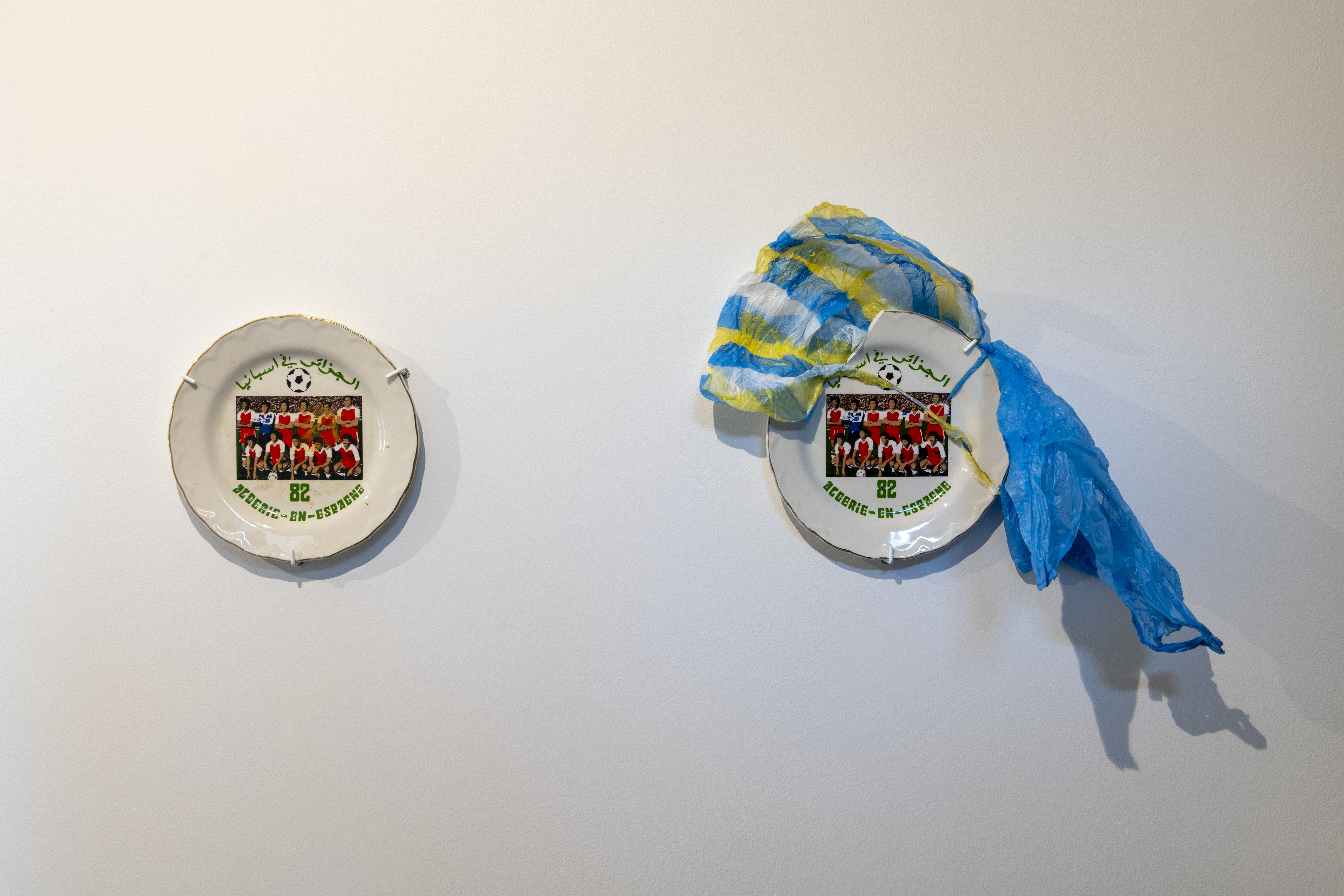
Plates, plastic bags
Some images are like homes. They watch us grow up and, in turn, provide landmarks that mark the passage of time. They are stuck on the walls of a teenager’s bedroom or proudly framed in a family living room. They are sometimes still mass-produced on decorative plates, like one of this pair that has always been on the sideboard in Ouassila Arras’s family apartment. The image of the 1982 Algerian soccer team is crystallized in the enamel – a team that should have won its match against Austria, but whose qualification for the World Cup was thwarted by match-fixing. The details of the story are soon forgotten, but to those growing up in front of their frozen image, the players become resistance fighters, heroes, and even members of the family.
When the artist’s brother later finds the same plate at a flea market in Algeria, he brings it back to him as a trophy – albeit a broken one – of a shared memory that has shifted. The story of these players who fought against inequality mirrors that of these two plates, which echo one another across market stalls and through time.
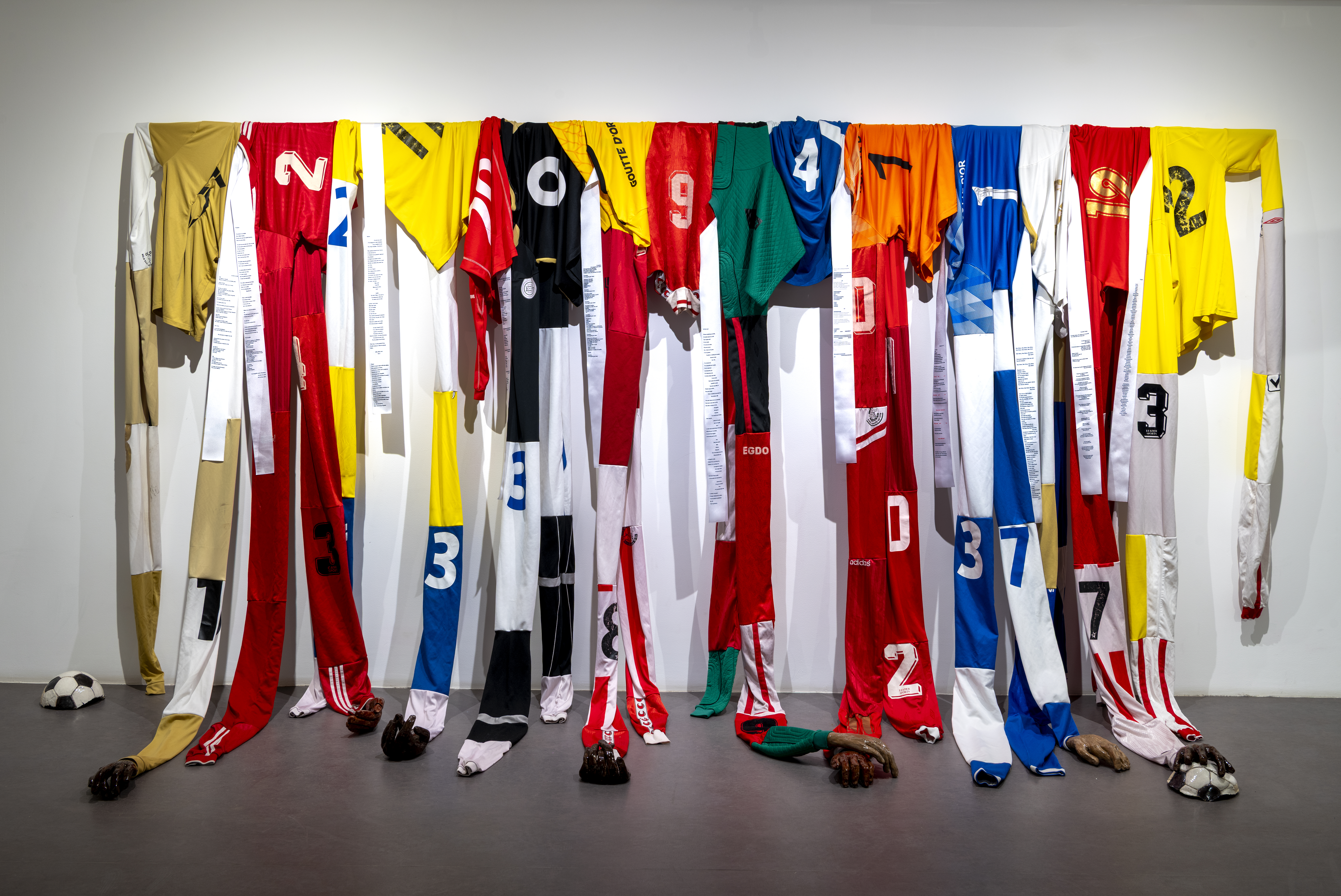
Eleven soccer jerseys, eleven poetry tags, ceramic and porcelain hands and balls
The soccer jerseys donated to M’barka Amor by the Enfants de la Goutte d’Or association – a neighbor of ICI – drip all the way to the floor. Their arms hang limply; time stands still. Before or after exertion, wrung out, drying or resting, they wait for dreams to blossom, for bodies to take shape, for paths not yet fully mapped out to emerge. They bear the invocations in the form of poems that the artist has woven onto the tongues. At the ends of sleeves stretching toward the elusive, ceramic hands cross their fingers for good luck or rest one upon the other, somewhere between prayer and hope.
In the journey undertaken by the young players described here, the body is put to the test. As they learn the skills needed to become professional soccer players, they grow up amid social pressures and the clash between those pressures and their dreams of success. M’barka Amor sifts through hopes and obstacles until exhaustion, wrapping them in incantatory words that protect the children’s bodies and aspirations.
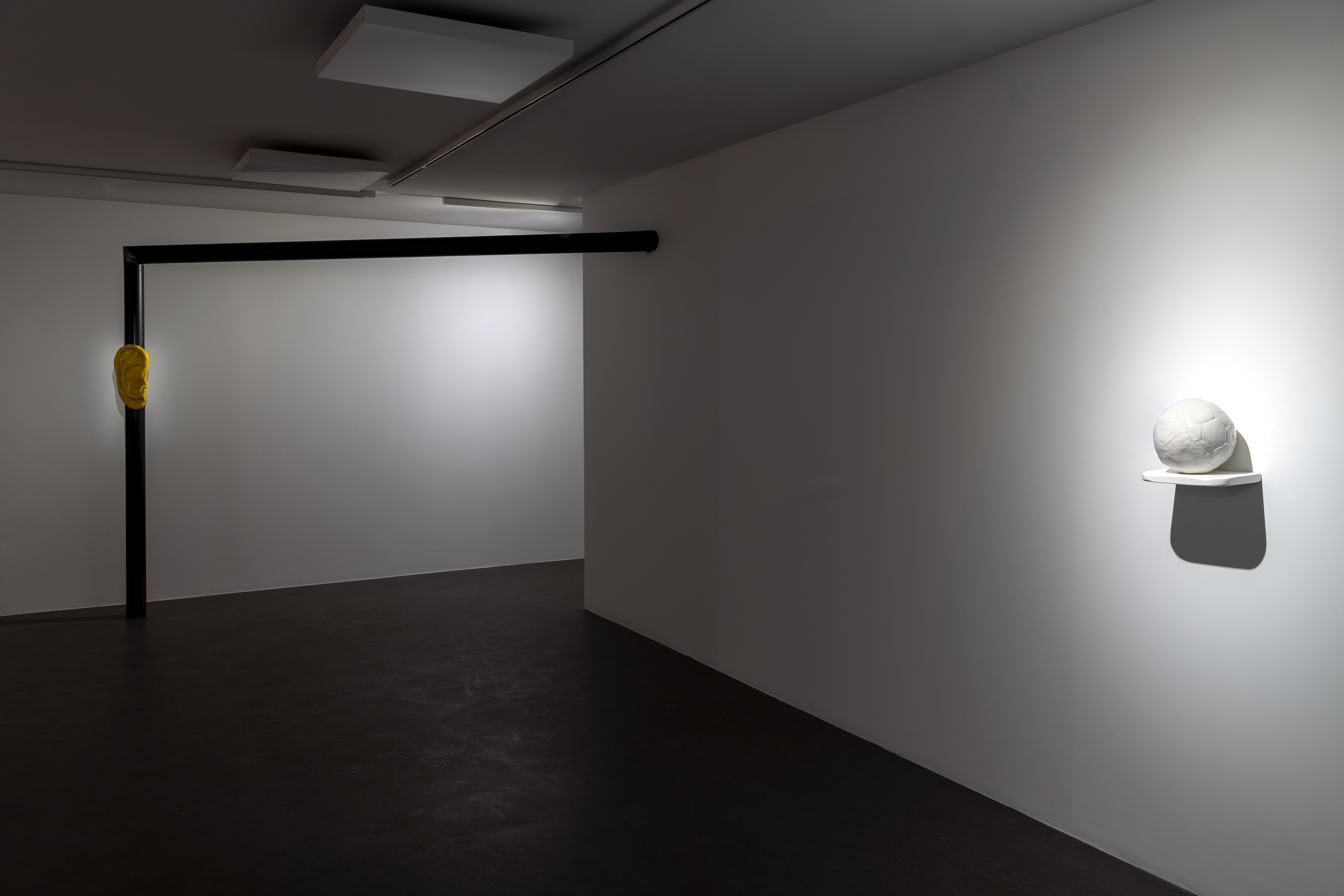
Metal cage with ceramic ear cups, ratchet strap
The cage is both a target and a fortress, a threshold and a barrier. Usually fiercely guarded to prevent the opponent from scoring a goal, M’barka Amor transforms it into a passageway and a receptacle. Cut in two, it is scattered across the exhibition’s floors, mimicking a door here, a minimalist sculpture there. On each of its edges, a ceramic ear strains to listen to the murmurs, the clamour, and the secrets, as well as their myriad ways of growing or fading away.
Space 2
Ten oil paintings on linen canvas, ten ceramic frames
For years, Dalila Dalléas Bouzar has focused on capturing bodies and faces: painting the flesh to better reveal what lies within, painting what the eyes both hide and reveal. While the dreams scattered throughout every corner of the exhibition are not always named, the artist offers a panorama of the faces that carry them. This series of portraits was created at the Enfants de la Goutte d’Or soccer club, where the artist painted the young players – both boys and girls – who agreed to participate. Here, the frankness of a gaze that dives directly into the eyes of visitors expresses pride; there, a sly smile betrays impatience… It is in them that souls are read; it is through the portrait that childhood is revealed.
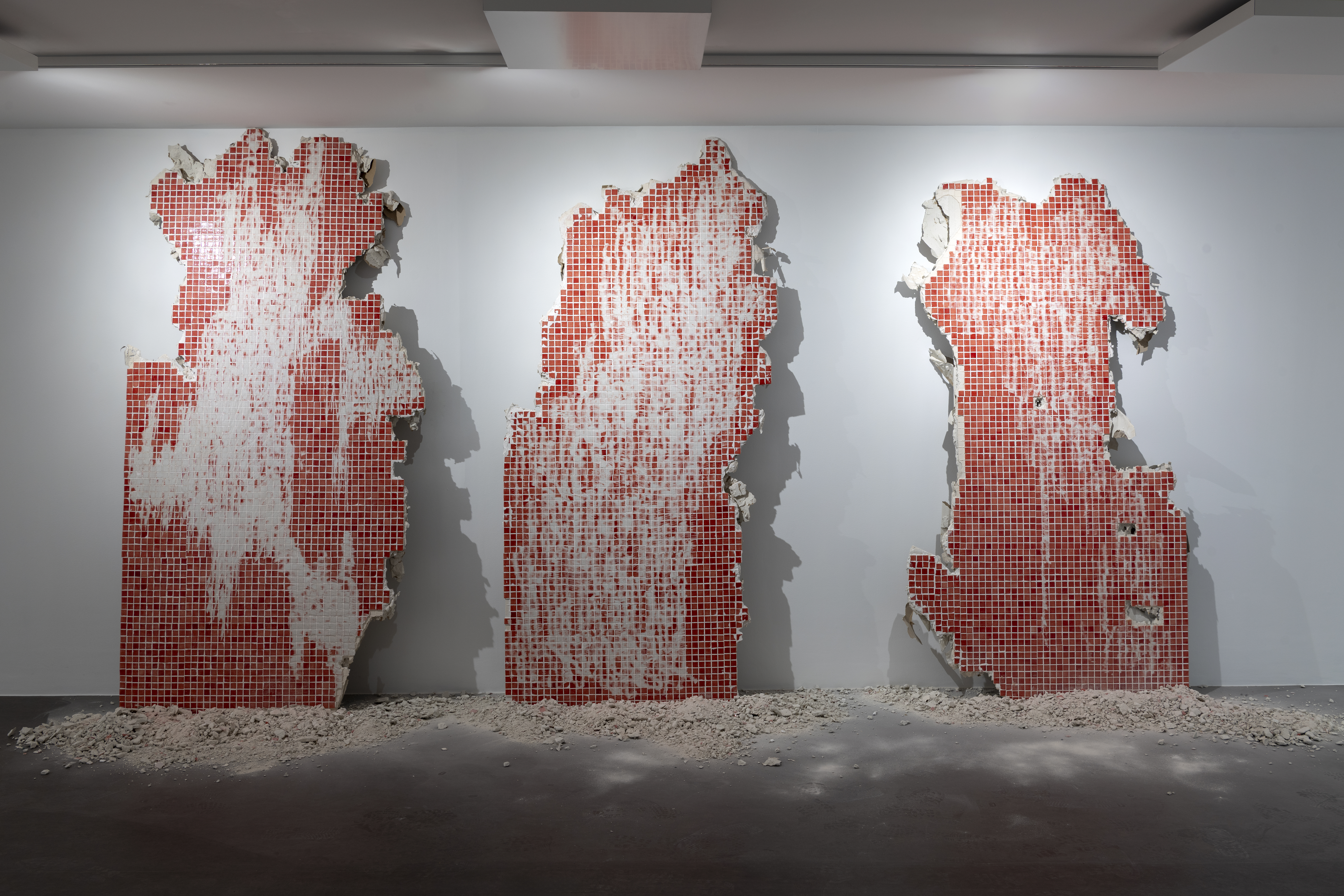
Drywall, tiling
A locker room, a hammam, and a construction site have more in common than one might think. Everywhere, sweaty bodies –scratching or being scratched, digging and building, falling and getting back up. In her consistently large-scale installations, Ouassila Arras sometimes echoes the gestures of her father, a public works laborer, and sometimes those of her mother, when she would accompany her to the hammam and scrape her back almost until it bled. With method, vigor, and patience, the artist has in turn scraped the walls she herself built and tiled.
The color of the ceramic tiles is that of the flesh beneath the skin, of the muscles that the artist rubs and scrapes, leaving a layer of white dust on the floor. Exposed raw, they hint at the strain imposed on bodies to make them conform to the norms dictated by majorities ill-equipped to accommodate nuance. Along with them crumble the beings who are pushed, at all costs, to adapt, and whose suffering the artist seeks to bring to light – suffering that is often too painful to name.
Space 3
ACT 2 – Intermission
Halfway through the game, the break. The one that marks the transition from childhood to adolescence. The one that comes at a crossroads, when a choice must be made. The one after which the cards are reshuffled, and one must either keep going or redouble one’s efforts. The analogies and parallels presented upstairs by the artists highlight these strategies of resistance developed by the body to continue growing and to nurture certain dreams.
In the middle of the exhibition, several paths emerge in response to the oppression and stigmatization encountered along the way. Fueled by anger, frustration, and/or empathy – depending on the individuals as well as the moments in life – protective shells form as bodies bend. Moving forward while shouting, shouting to resist, resisting through laughter, laughing to survive, surviving by looking away. The sleights of hand are numerous, complementary, sometimes contradictory, and here explored by the artists along an obstacle course that is overcome by crafting one’s own game.
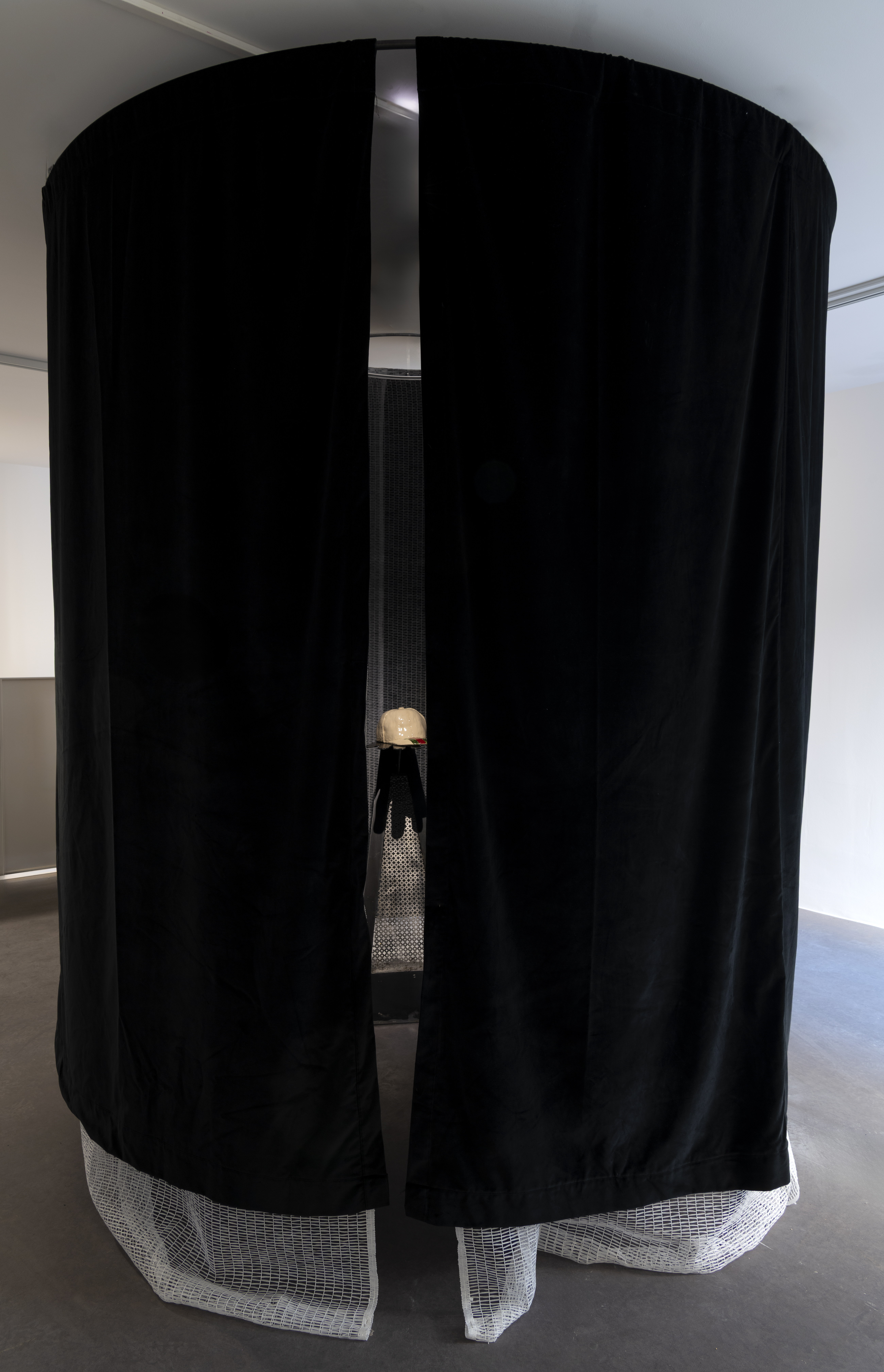
Sound installation, 7 minutes, metal, fabric, and ceramic
During an artist residency she undertook in Trappes in the fall of 2025, M’barka Amor met with the U14 and U17 players from the Étoile Sportive Trappes soccer club. Working with the teenagers, the artist spent time listening to, recording, and collecting the dreams and hopes they were willing to share with her.
She invites visitors to step inside the installation to hear the soundtrack created from these encounters, which she sets in dialogue with a ceramic cap featuring the three Gucci stripes, placed on a hand-shaped pedestal. The group talks, laughs, and jokes about a very serious subject: soccer. A poem, like a mantra, sets the rhythm of the discussion and accompanies it, shielding it through the repetition of magical words. Dreams need space.
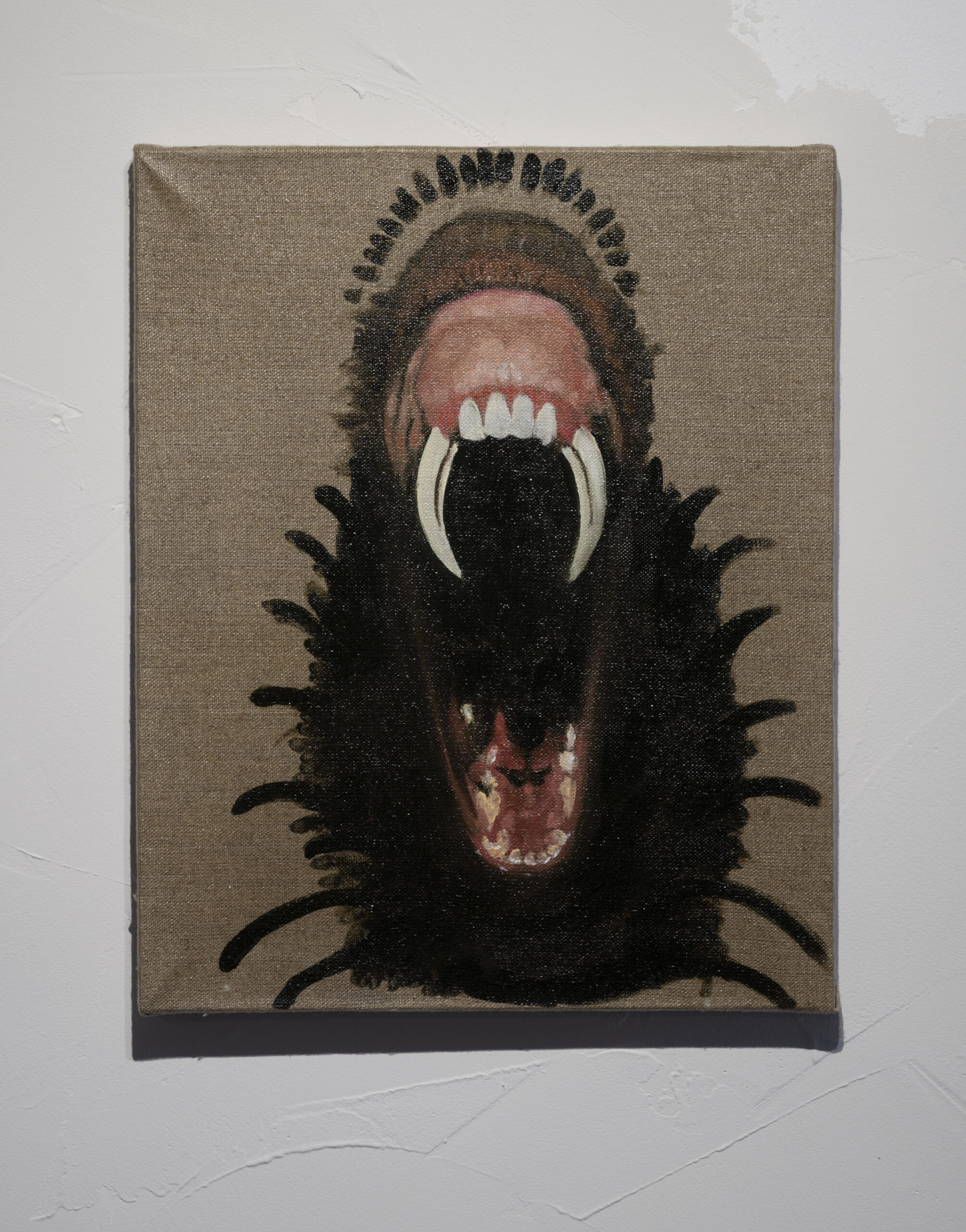
Oil on linen canvas
At visitors’ eye level, wide-open monkey fangs seem ready to swallow them whole. From their tips, they defy gazes, preparing to overturn them. It is in the tradition of Kateb Yacine and Louisa Yousfi – and in the need to reverse the stigma attached to the word “barbarian” – that the series Rester barbare was born. From canvas to canvas, along the exhibition route, shame and insult become trophies, fangs become jewels, the binary takes on nuance, and the spectrum of humanity is reconstituted.
Space 4
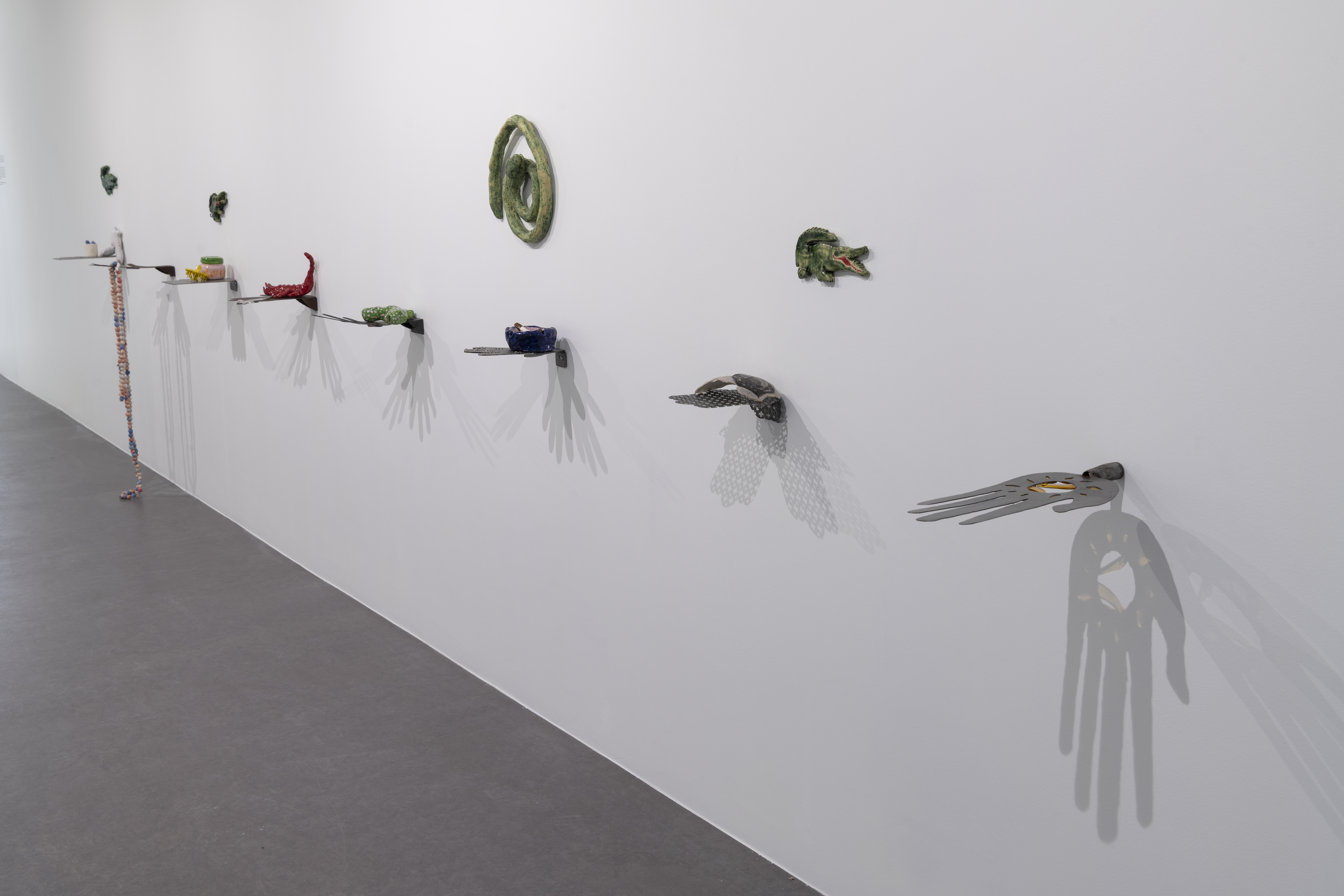
Ten altars, metal, ceramics, and various objects
One eye, five fingers, and a palm make a hand.
It is called a khamsa or the Hand of Fatima; it wards off the evil eye. Along the walls, accompanied by talismanic objects, M’barka Amor’s metal hands reinterpret this symbol, which has become a spontaneous gesture in popular culture for communicating with the invisible world, between heaven and earth.
Scattered along the route by the artist, they accompany the race and, along its twists and turns, celebrate love and joy in a burst of energy that brings intensity to our lives.
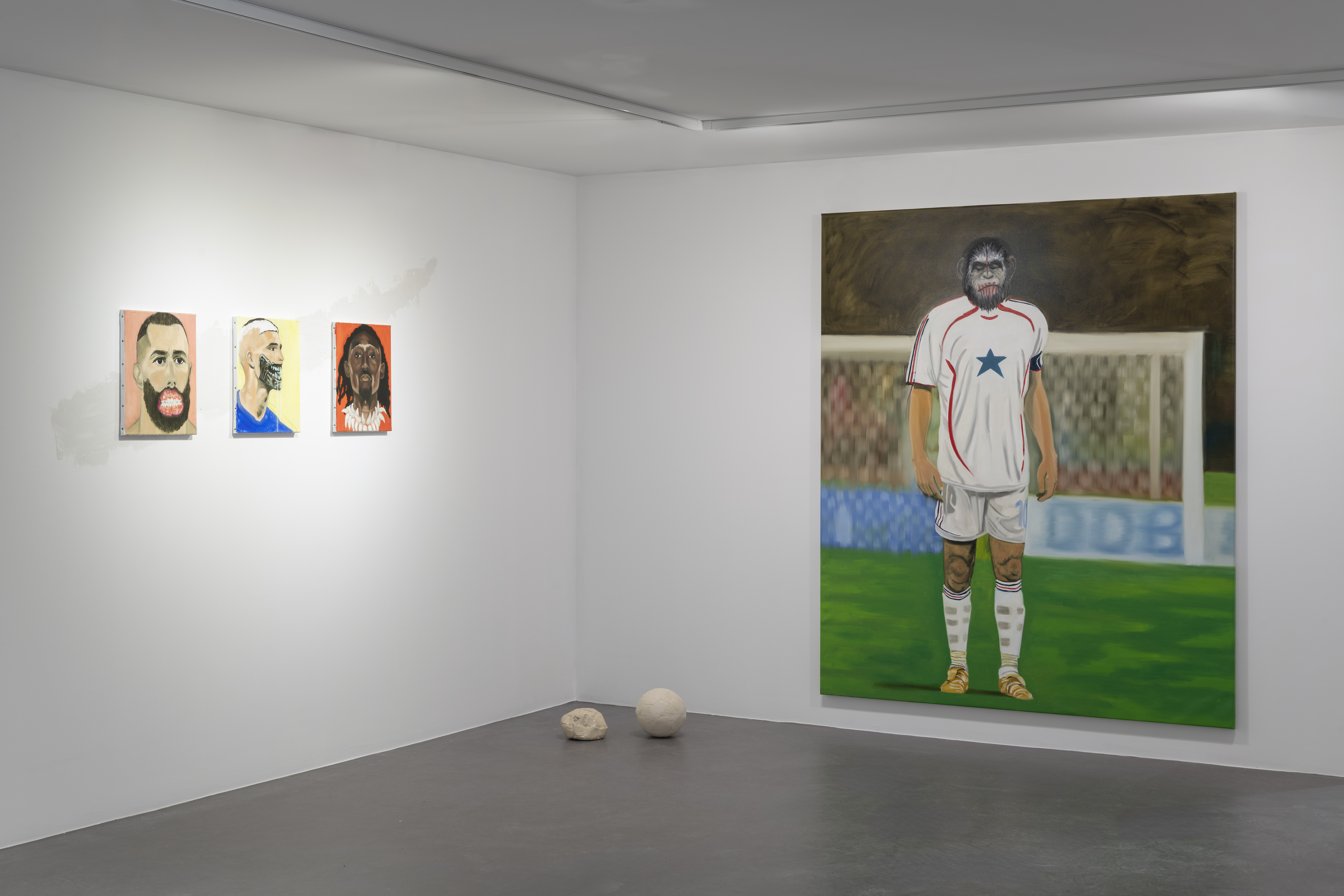
Oil paintings on linen canvas
The eyes of the players depicted here by Dalila Dalléas Bouzar may remind some viewers of their names. However, the painter complicates the process of identification by blending their faces with other jawlines. By pairing their gazes with the teeth of a monkey or an Alien, the faces of certain soccer players – who are global icons to some – serve as a reminder that they remain monstrous symbols of barbarism to others. Success, glory, and wealth are never guarantees of equality.
It is by their teeth that we have always estimated the age of people without official documents; it is by their teeth that we identify the dead and that we used to check the health of slaves’ bodies. The artist overturns this stigma, attempting through her brushstrokes to restore the dignity that certain words deny, and to reconnect the teeth that were made to speak with the eyes that tell stories.
In this full-length portrait, Dalila Dalléas Bouzar subverts the iconic image of the soccer player to offer a unsettling and political reinterpretation. Zinedine Zidane’s recognizable body is here topped by the head of Caesar, the emancipated ape who became the leader of his peers after freeing himself from captivity, in Pierre Boulle’s novel Planet of the Apes. The painted face, as if marked for battle, places the character in a tension between humanity and animality, heroic representation and collective struggle.
Space 5
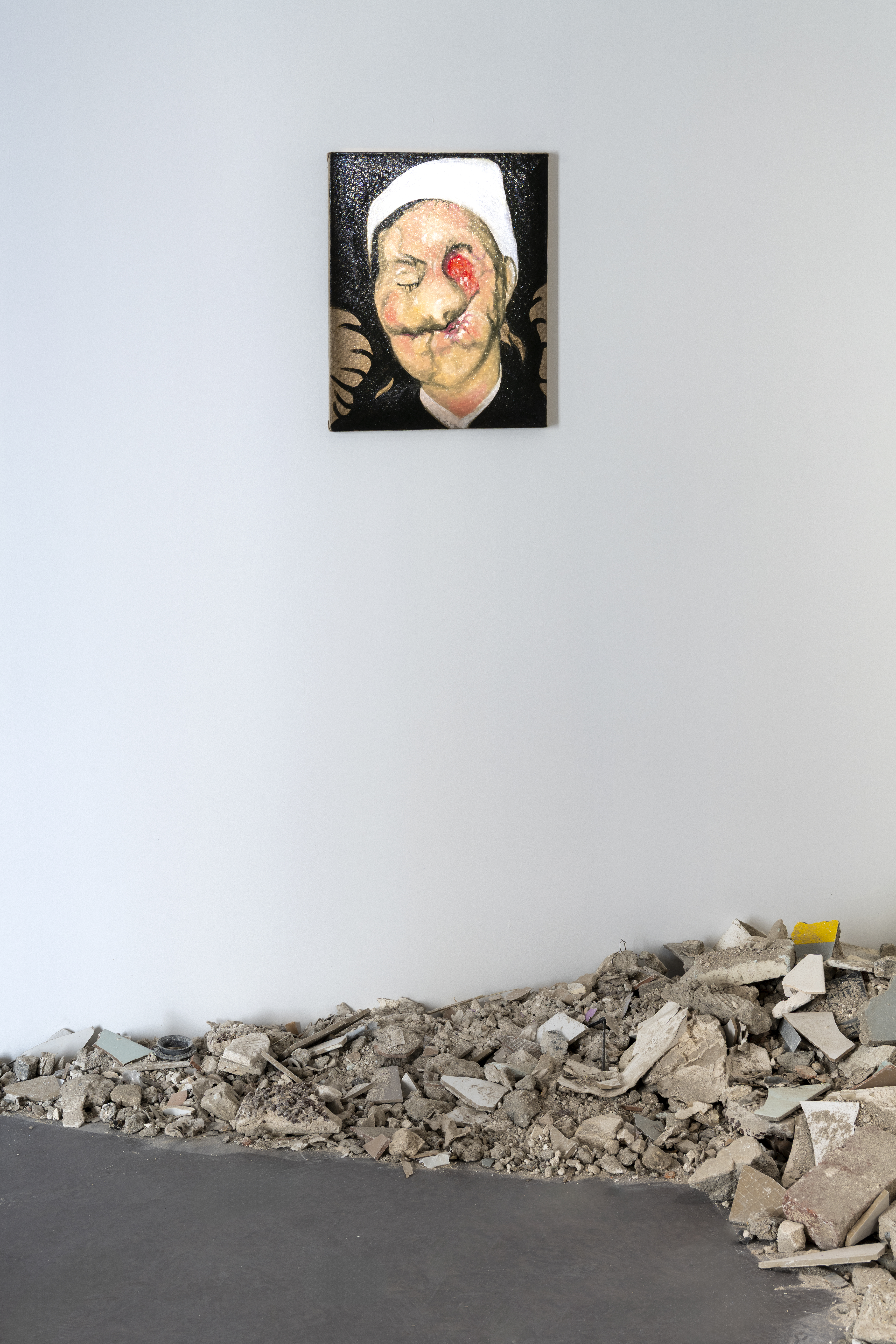
Oil on linen canvas
On February 16, 2009, in Stamford, Connecticut, a quiet suburb became the scene of a tragic incident. Charla Nash was attacked by the chimpanzee that her neighbor thought she had successfully domesticated. The animal, named Travis and a former television star, disfigured her during an episode reportedly linked to antidepressants that had been prescribed to him following a medical diagnosis. He was shot dead immediately, but the American woman’s face was destroyed. Her image went viral, becoming a symbol of animal savagery that will always resurface – of the barbarity also attributed to certain living beings, whom we humanize and dehumanize as events dictate. The raw flesh depicted here by the artist prompts a reflection on the face as a vehicle of humanity: it is the face that the animal attacks, and it is the face that is denied to certain beings whom we prefer to refer to by numbers rather than by names and portraits.
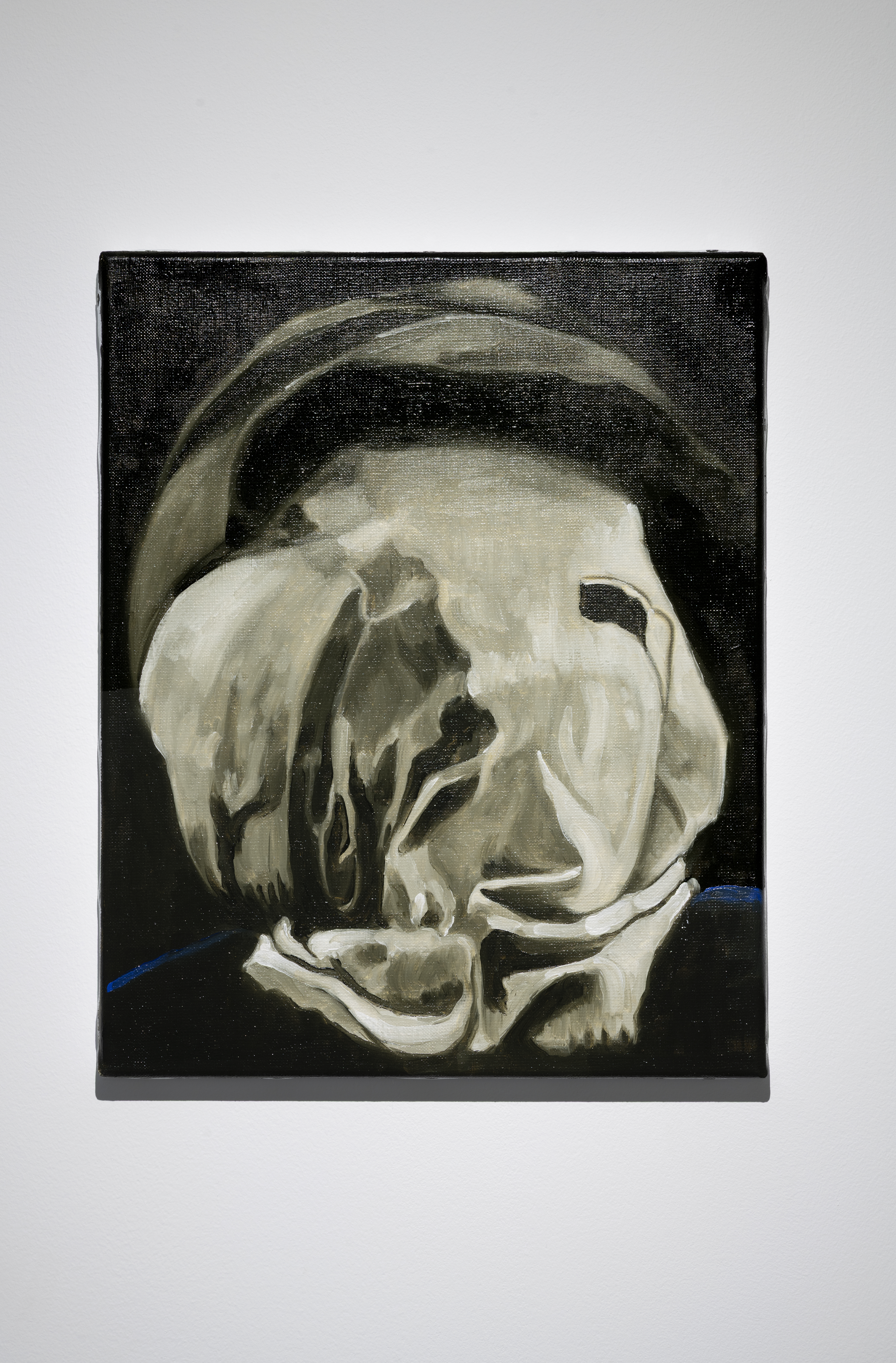
Oil on linen canvas
Throughout the 18th and 19th centuries, freak shows were all the rage in Europe. They showcased “monsters” who did not conform to societal norms, even as they were hidden away and excluded from everyday life. Joseph Carrey Merrick, better known as the Elephant Man, joined the circuit of his own free will, even as the Proteus syndrome from which he suffered turned him into society’s outcast. Immortalized by popular culture and David Lynch’s film, he is depicted here half-hidden beneath the cape he wears in the movie, which Dalila Dalléas Bouzar has transformed into a burnous. Through painting and this noble garment, the artist transfigures him and attempts to reverse the shame. Set against the ruins of Ouassila Arras and a face in tatters that has been seen around the world, he seems to cast a discreet glance from beneath his hood and, in turn, attempts to shift the contours of what constitutes “humanity.”
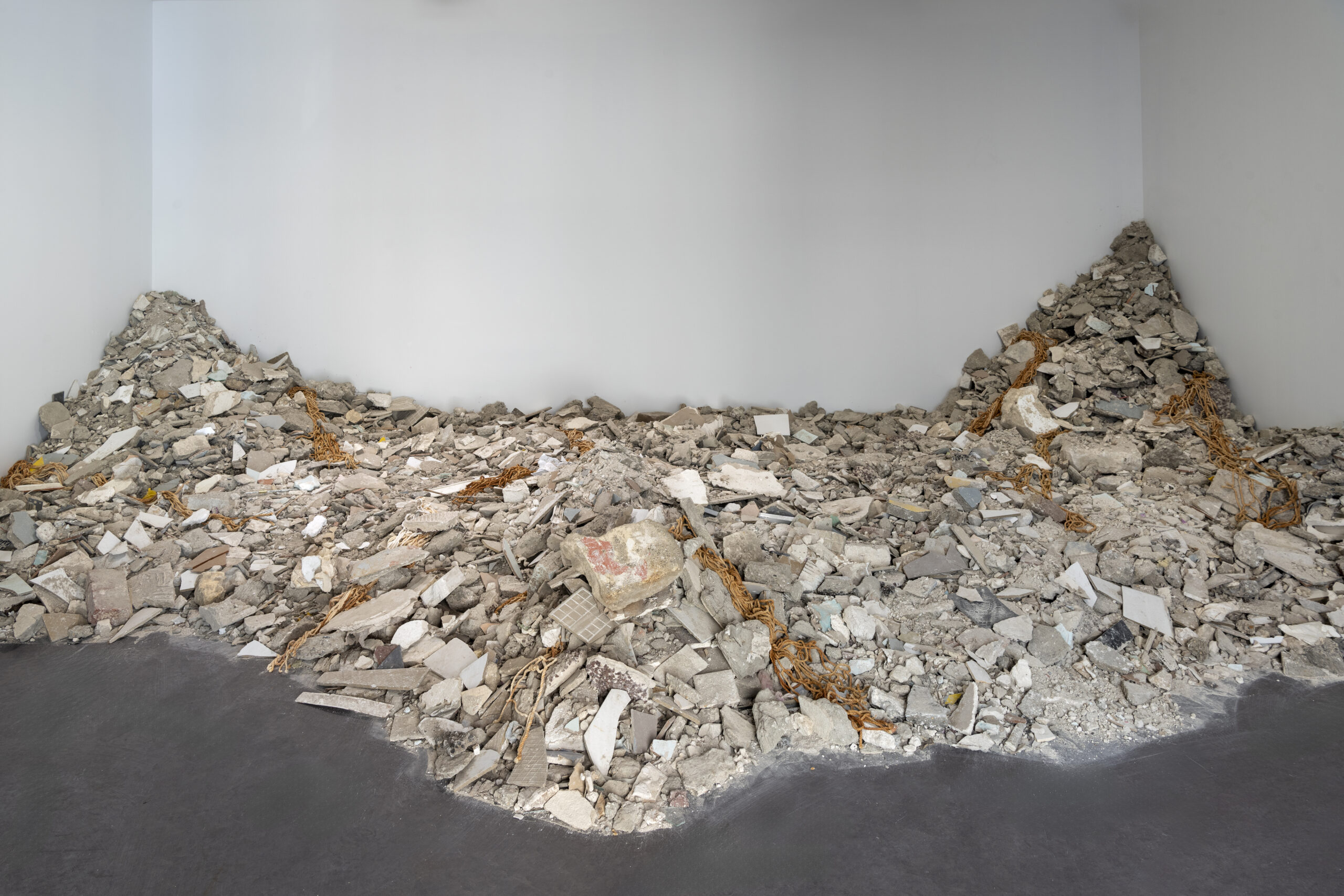
Rubble, henna, soccer net
Piles of rubble are scattered on either side of the wall that divides the installation in two. They were collected from construction sites and have been used to re-create memories and the artist’s visions of spaces that no longer exist…
Space 6
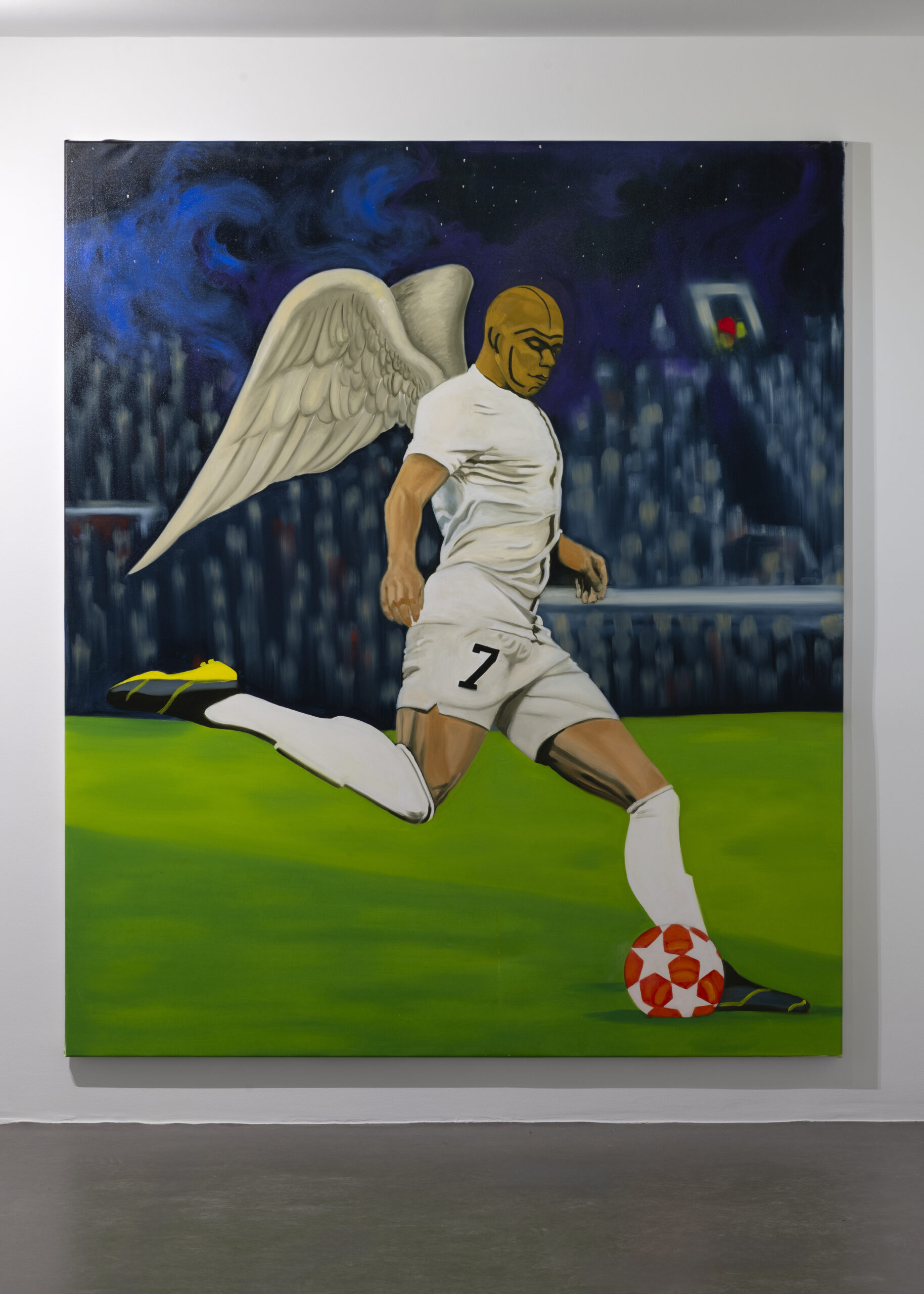
Oil on linen canvas
In this painting, Dalila Dalléas Bouzar depicts the figure of a soccer player – not to celebrate it, but as a starting point for a reflection on the male body. Rather than viewing it as an athlete’s body, she focuses on the socially situated body – that of innocent children who have become famous men. Often of Black or Arab immigrant backgrounds, their visibility, for the painter, entails a responsibility within the social and political sphere that is all too often overlooked.
While her painting captures the grace of Kylian Mbappé’s movement and the sculptural beauty of his face, this elevation does not obscure the critical dimension of the artist’s gaze; on the contrary, it sharpens it, revealing the tensions that run through these exposed bodies.
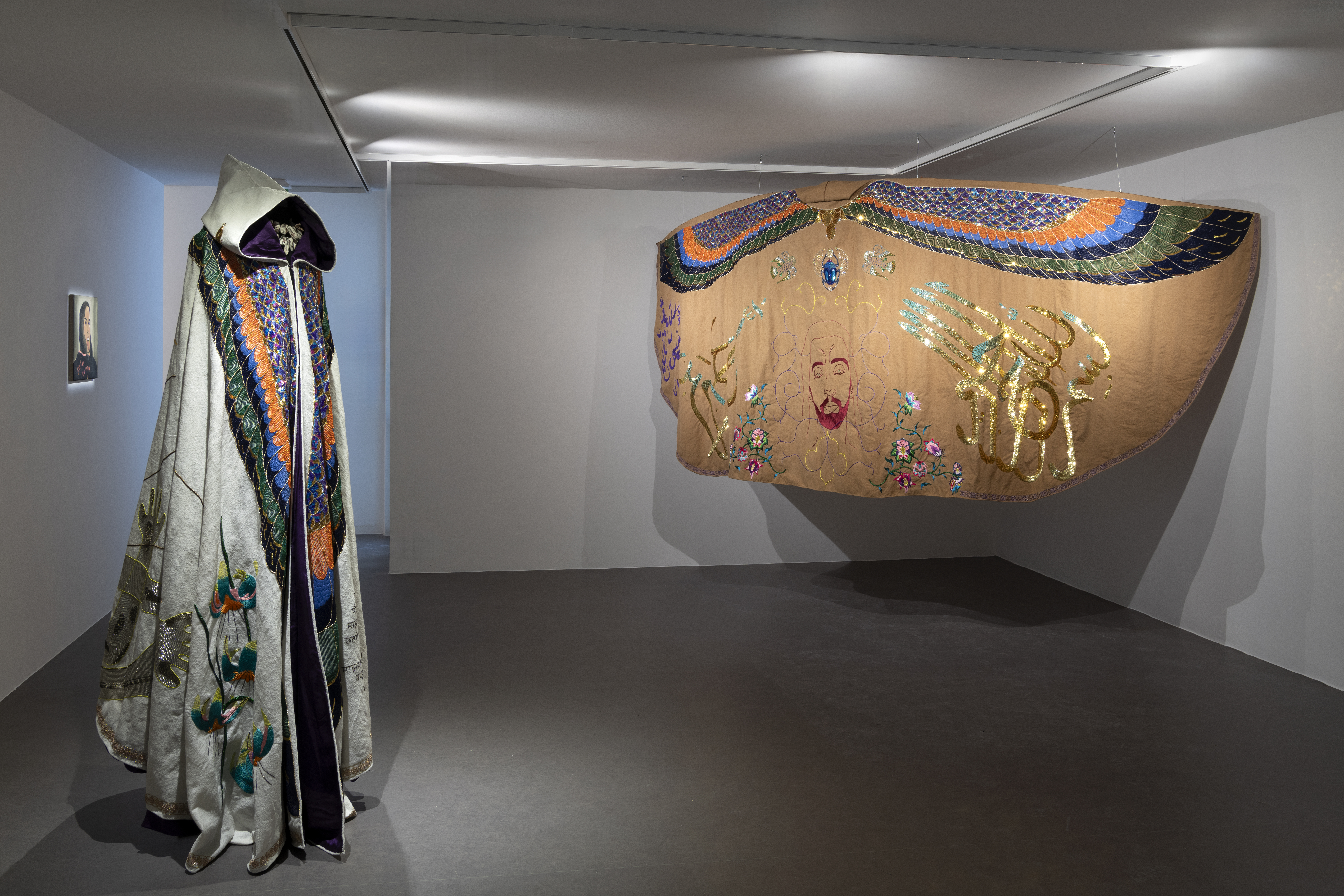
Two Algerian burnouses woven from sheep’s wool and camel’s wool, with embroidery and various materials
Long disparaged in the colonial imagination, the burnous is an iconic garment of North Africa, particularly in Algeria, where it is a symbol of dignity, nobility, and social status. Here, Dalila Dalléas Bouzar revives this garment, handwoven using ancestral techniques, which carries on the tradition of travel blankets from nomadic cultures. Made of camel or sheep’s wool, it wraps around the body and moves with it, making travel an experience that is both physical and symbolic.
The artist has embellished these burnouses with exquisite embroidery – beads, sequins, gold thread, and silk – created in collaboration with artisans from the Kalhath Institute in India. The faces of NOs – singer of the group PNL – and Djamila Bouhired – an Algerian resistance fighter who burst out laughing upon her death sentence – appear there in majesty, surrounded by religious references ranging from ancient Egypt to the Hindu pantheon, including Christian iconography and Muslim prayers. By adorning the bodies with these syncretic divine attributes, Dalila Dalléas Bouzar places them within a spiritual space while simultaneously engaging with their power, memory, and dignity.
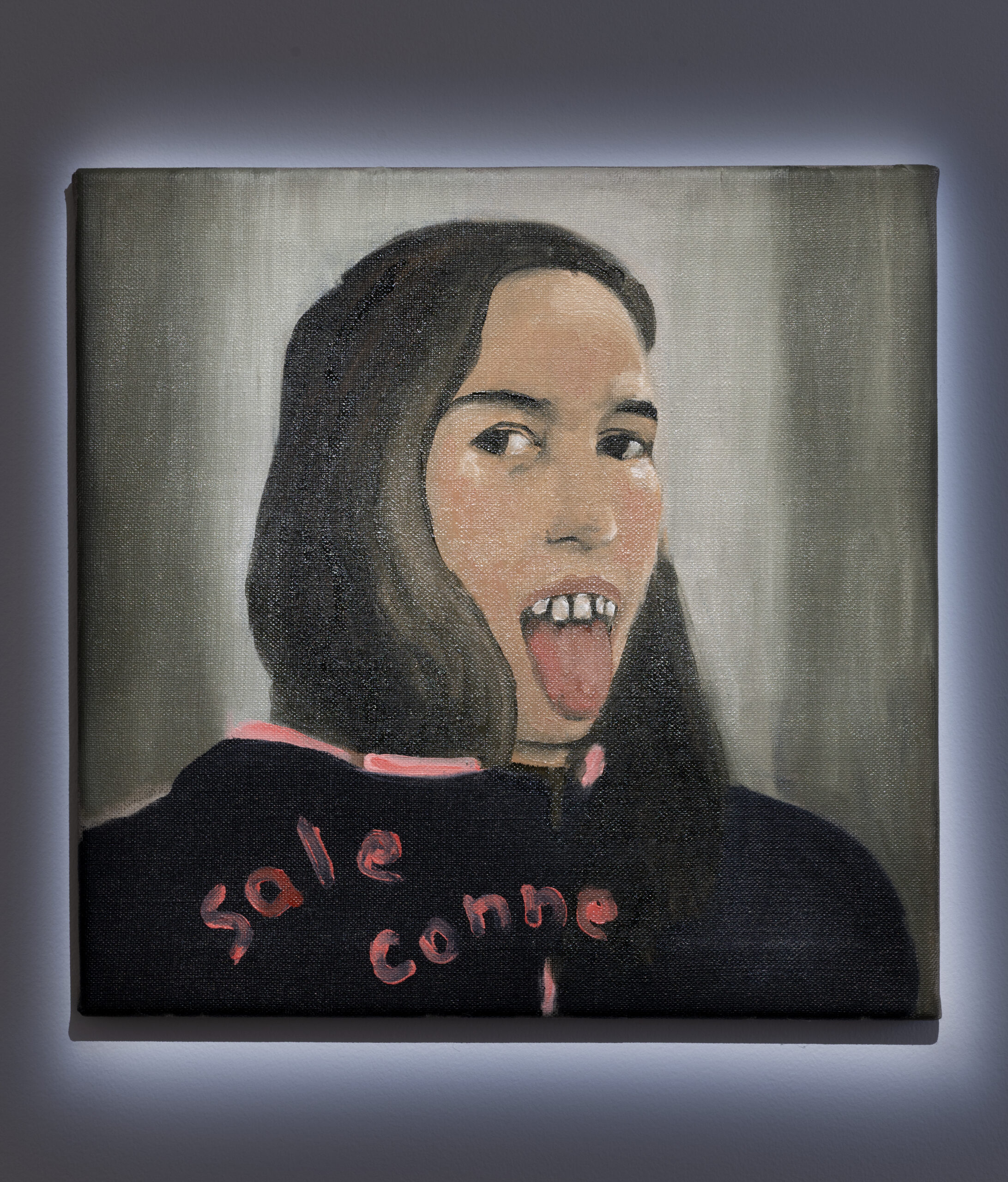
Oil on linen canvas
Dalila Dalléas Bouzar’s self-portrait features the figure of the painter – a woman of color – in her series Rester barbare, through which she sketches the contours of a community bound by a shared destiny. To those who recognize themselves in it, she urges resistance, with pride and dignity. The witch’s teeth she often wears in her performances – and with which she appears here – cast a counter-spell against prejudice and unabashed insults. Behind the profanity, invisible yet omnipresent, lies a promise: together, we will be stronger.
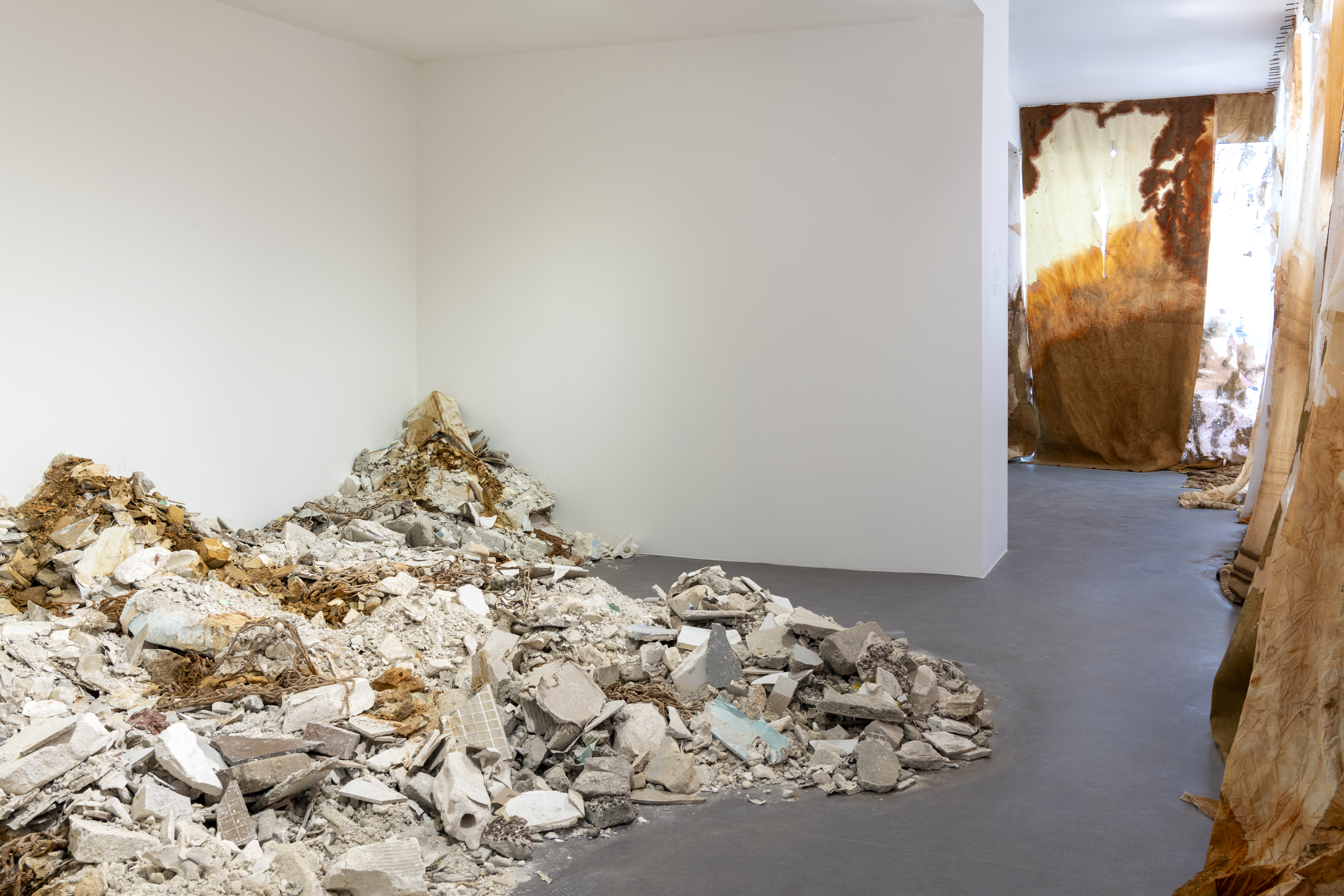
Rubble, henna, soccer net
Henna drips from the pile. Usually used to dye, decorate, and/or purify the body parts to which it is applied, here it seeps into the cracks of the ruins arranged by the artist and oozes out from their crevices. It is absorbed and expelled; it dries and corrodes at the same time; it spreads from the curtains drawn opposite by the artist to the piles of deconstructed materials in the space. It seeps in, flows, and changes color as visitors pass by and throughout the exhibition.
The war memorial is alive. It pays tribute to the buildings, apartment complexes, and stadiums that the artist’s working-class father spent decades building, and brings back to life those that were destroyed or modernized during the urban renewal projects that have been all too familiar to so-called “peripheral” cities since the late 1990s. The landscape was marked by these vacant lots that children – including Ouassila Arras – quickly turned into playgrounds. It also gives voice to the silenced cries of weary and stigmatized bodies, of damaged and wounded bodies, of bodies buried under the rubble.
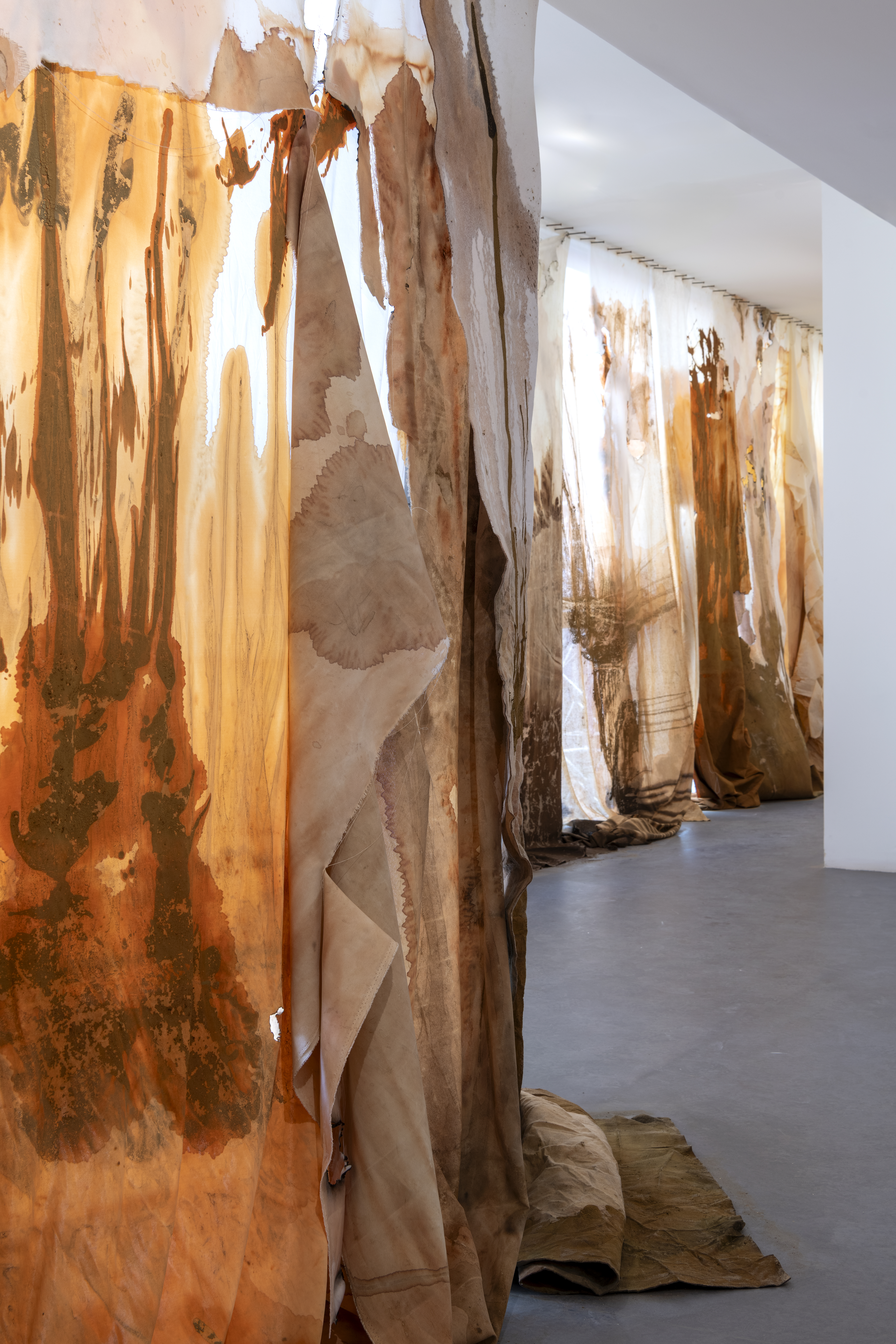
Mixed media, rusty nails, henna, rust
The curtains arranged along the passageway by Ouassila Arras are slowly being devoured by the henna and rust she has applied to their folds. The oxidation process – usually controlled to create certain textile patterns – is here left to the material itself and continues throughout the exhibition. The rust that will soon consume the fibers mirrors the corrosion of bodies damaged by society’s norms and dictates. Slowly but surely, the oppressions that perpetuate hierarchies among bodies, cultures, and beings – despite all the promises of liberty, equality, and fraternity – nibble away at flesh and soul until exhaustion.
Space 8
ACT 3 – Extra Time
What becomes of dreams when the system catches up with them? How do bodies evolve when norms strive to constrain them? How can we keep hope alive in a torn world? The tension builds from portraits to rubble, from protective hands to outstretched wings, from fangs to smiles, from wounds to promises: it was there from the start, invisible, hidden. It reveals itself through trials, grows with each obstacle, and comes to light as society exercises its racist, sexist, classist, and ableist biases.
It leaves bodies and dreams exhausted, longing for rest. At the end of the journey the artists have laid out, there are no ready-made solutions or definitive endings. But perhaps there are at least some paths to explore further – on one’s own and with others, in whom one has found kindred spirits.
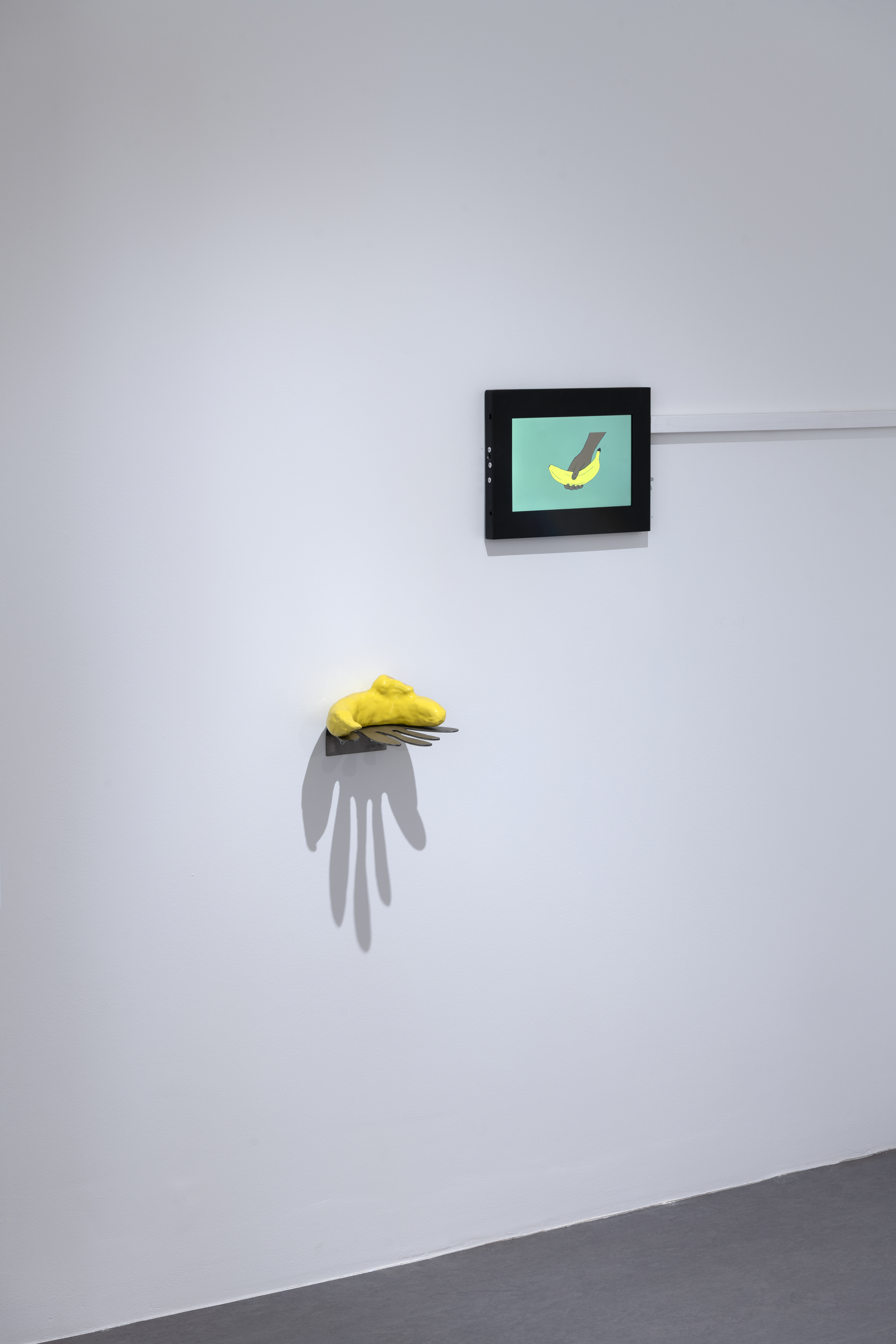
Animated short film, 1 minute
In 2014, during a Spanish League match, FC Barcelona player Dani Alves picked up a banana thrown at him from the stands, peeled it, and ate it. The gesture quickly went viral around the world and on social media, praised for its boldness in the face of racist abuse – a regrettably all-too-common occurrence in European stadiums. He was supported by the equally iconic player Neymar, who, a few days later, posted an image on Instagram of himself and his son holding bananas. This gave rise to the hashtag #SomosTodosMacacos (We Are All Monkeys), which spread in Portuguese, English, Spanish, and Catalan, and to a global anti-racist protest movement within the sports world. The animation created by M’barka Amor highlights the power of this gesture and amplifies the capacity for action that Black and Arab people are often denied.
Dani Alves was convicted of rape in 2024 and acquitted in 2025. The victim has filed an appeal.
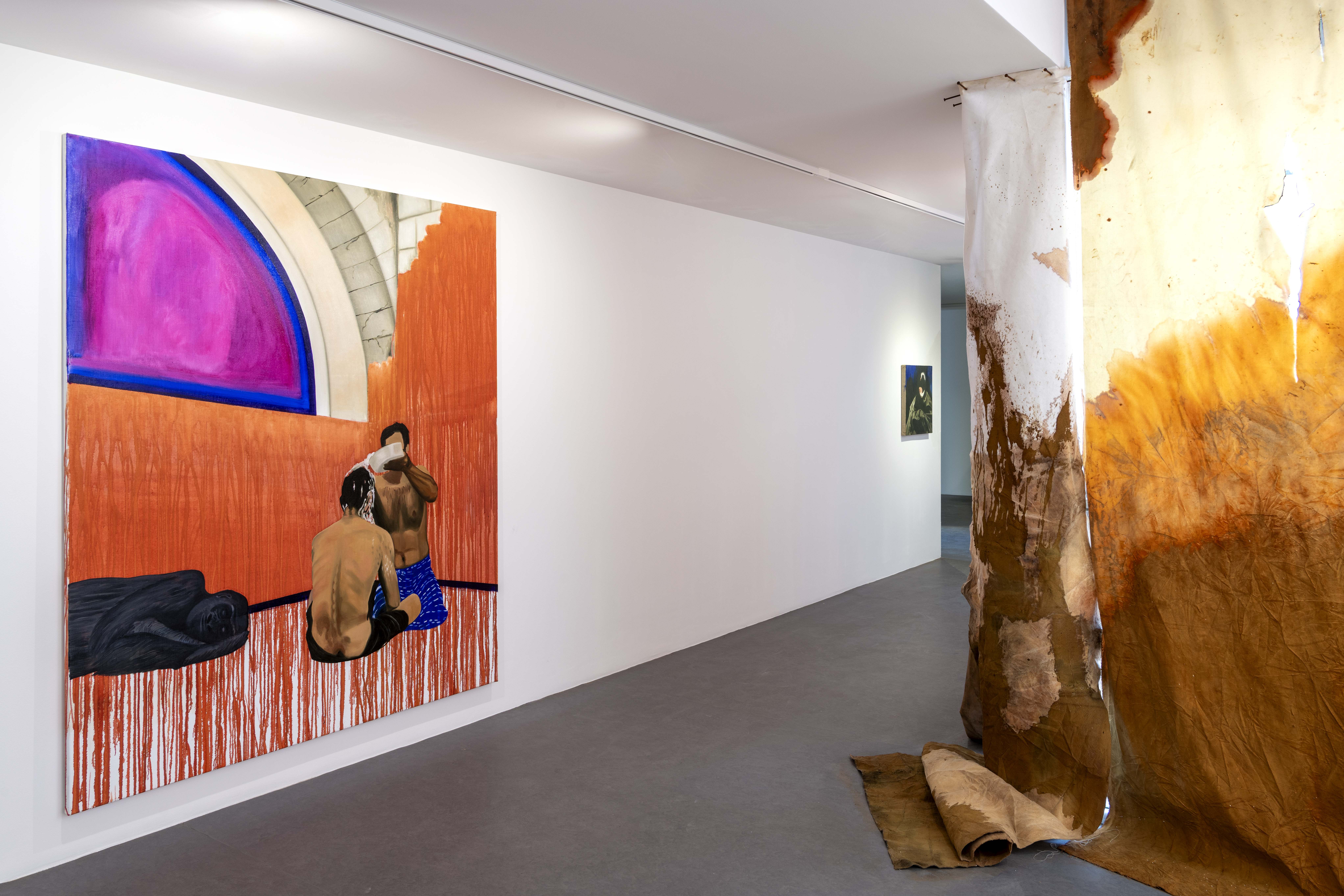
Oil paintings on linen canvas
In the hammam, bodies wash and rest, reveal their secrets, and no longer need to pretend. Here, everyone has rediscovered their body: men rub shoulders with the monkey that Dalila Dalléas Bouzar paints in full for the first time. It sleeps peacefully beside bodies busy caring for one another, bodies that seem not to notice it. Rest is as much a political horizon as it is a survival strategy for bodies in constant struggle.
